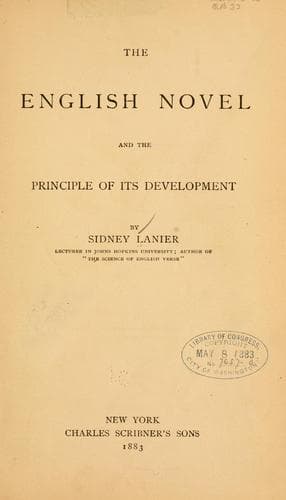
The English Novel and the Principle of its DevelopmentLanier, Sidney
History
The English Novel and the Principle of its Development
Lanier, Sidney
English fiction -- History and criticism
O my God!
I, standing here between the glory and dark,--
The glory of thy wrath projected forth
From Eden's wall, the dark of our distress
Which settles a step off in that drear world,--
Lift up to Thee the hands from whence hath fallen
Only creation's sceptre,--thanking Thee
That rather Thou hast cast me out with _her_
Than left me lorn of her in Paradise,
With angel looks and angel songs around
To show the absence of her eyes and voice,
And make society full desertness
Without her use in comfort!
Because with _her_, I stand
Upright, as far as can be in this fall,
And look away from earth which doth convict,
Into her face, and crown my discrowned brow
Out of her love, and put the thought of her
Around me, for an Eden full of birds,
And with my lips upon her lips,--thus, thus,--
Do quicken and sublimate my mortal breath
Which cannot climb against the grave's steep sides
But overtops this grief!"
XI.
The fullness of George Eliot's mind at this time may be gathered from
the rapidity with which one work followed another. A book from her pen
had been appearing regularly each year. The _Scenes from Clerical
Life_ had appeared in book form in 1858, _Adam Bede_ was printed in
1859, _The Mill on the Floss_ came out in 1860, and now, in 1861,
followed _Silas Marner, the Weaver of Raveloe_. It is with the
greatest reluctance that I find myself obliged to pass this book
without comment. In some particulars _Silas Marner_ is the most
remarkable novel in our language. On the one hand, when I read the
immortal scene at the Rainbow Inn where the village functionaries, the
butcher, the farrier, the parish clerk and so on are discussing
ghosts, bullocks and other matters over their evening ale, my mind
runs to Dogberry and Verges and the air feels as if Shakspeare were
sitting somewhere not far off. On the other hand, the downright
ghastliness of the young Squire's punishment for stealing the
long-hoarded gold of Silas Marner the weaver, always carries me
straight to that pitiless _Pardoner's Tale_ of Chaucer in which gold
is so cunningly identified with death. I am sure you will pardon me if
I spend a single moment in recalling the plots of these two stories so
far as concerns this point of contact. In Chaucer's _Pardoner's Tale_
three riotous young men of Flanders are drinking one day at a tavern.
In the midst of their merriment they hear the clink of a bell before a
dead body which is borne past the door on its way to burial. They
learn that it is an old companion who is dead; all three become
suddenly inflamed with mortal anger against Death; and they rush forth
resolved to slay him wherever they may find him. Presently they meet
an old man. "Why do you live so long?" they mockingly inquire of him.
"Because," says he,
Public-domain text, read in full here on John Shaqi.
Reviews
Reviews
No reviews yet
Be the first to share your thoughts on this work.
Elsewhere in the archive
Join the Discussion
Join the discussion
Sign in to leave a comment or review.
Sign InorCreate an account