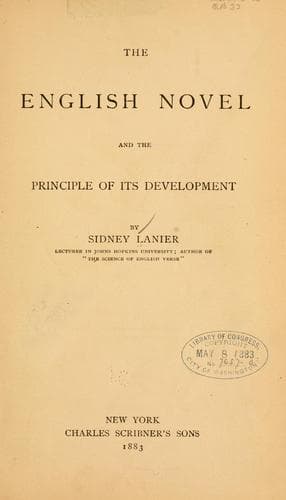
The English Novel and the Principle of its DevelopmentLanier, Sidney
History
The English Novel and the Principle of its Development
Lanier, Sidney
English fiction -- History and criticism
which had for years stood filled with rain-water near his house,
becomes dry, and on the bottom is revealed a skeleton with a leathern
bag of gold in each hand. The young man plunging out into the dark,
laden with his treasure, had fallen in and lain for all these years to
be afterwards brought to light as another phase of the frequent
identity between death and gold. Here, too, one is obliged to remember
those doubly dreadful words in _Romeo and Juliet_, where Romeo having
with difficulty bought poison from the apothecary, cries:
"There is thy gold; worse poison to men's souls,
Doing more murder in this loathsome world
Than these poor compounds which thou mayst not sell.
I sell thee poison, thou hast sold me none.
Farewell; buy food and get thyself in flesh."
I must also instance one little passing picture in _Silas Marner_
which though extremely fanciful, is yet, a charming type of some of
the greatest and most characteristic work that George Eliot has done.
Silas Marner had been a religious enthusiast of an obscure sect of a
small manufacturing town of England; suddenly a false accusation of
theft in which the circumstantial evidence was strong against him
brings him into disgrace among his fellow-disciples. With his whole
faith in God and man shattered he leaves his town, wanders over to the
village of Raveloe, begins aimlessly to pursue his trade of weaving,
presently is paid for some work in gold; in handling the coin he is
smit with the fascination of its yellow radiance, and presently we
find him pouring out all the prodigious intensity of his nature, which
had previously found a fitter field in religion, in the miser's
passion. Working day and night while yet a young man he fills his two
leathern bags with gold; and George Eliot gives us some vivid pictures
of how, when his day's work would be done, he would brighten up the
fire in his stone hut which stood at the edge of the village, eagerly
lift up the particular brick of the stone floor under which he kept
his treasure concealed, pour out the bright yellow heaps of coin and
run his long white fingers through them with all the miser's ecstasy.
But after he is robbed the utter blank in his soul--and one can
imagine such a blank in such a soul, for he was essentially
religious--becomes strangely filled. One day a poor woman leading her
little golden-haired child is making her way along the road past
Marner's cottage; she is the wife, by private marriage, of the
Squire's eldest son, and after having been cruelly treated by him for
years has now desperately resolved to appear with her child at a great
merry-making which goes on at the Squire's to-day, there to expose all
and demand justice. It so happens however that in her troubles she has
become an opium-taker; just as she is passing Marner's cottage the
effect of an unusually large dose becomes overpowering; she lies down
and falls off into a stupor which this time ends in death. Meantime
Public-domain text, read in full here on John Shaqi.
Reviews
Reviews
No reviews yet
Be the first to share your thoughts on this work.
Elsewhere in the archive
Join the Discussion
Join the discussion
Sign in to leave a comment or review.
Sign InorCreate an account