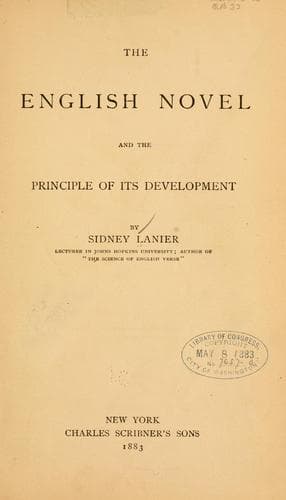
The English Novel and the Principle of its DevelopmentLanier, Sidney
History
The English Novel and the Principle of its Development
Lanier, Sidney
English fiction -- History and criticism
the little golden-haired girl innocently totters into the open door of
Marner's cottage during his absence; presently lies down, places her
head with all its golden wealth upon the very brick which Marner used
to lift up in order to bring his gold to light, and so falls asleep,
while a ray of sunlight strikes through the window and illuminates the
little one's head. Marner now returns; he is dazed at beholding what
seems almost to be another pile of gold at the familiar spot on the
floor. He takes this new treasure into his hungry heart and brings up
the little girl who becomes a beautiful woman and faithful daughter to
him. His whole character now changes and the hardness of his previous
brutal misanthropy softens into something at least approaching
humanity. Now, it is fairly characteristic of George Eliot that she
constantly places before us lives which change in a manner of which
this is typical: that is to say, she is constantly showing us intense
and hungry spirits first wasting their intensity and hunger upon that
which is unworthy, often from pure ignorance of anything worthier,
then finding where love _is_ worthy, and thereafter loving larger
loves, and living larger lives.
Is not this substantially the experience of Janet Dempster, of Adam
Bede, replacing the love of Hetty with that of Dinah Morris; of
Romola, of Dorothea, of Gwendolen Harleth?
This last name brings us directly to the work which we were specially
to study to-day. George Eliot's novels have all striking relationships
among themselves which cause them to fall into various groups
according to various points of view. There is one point however from
which her entire work divides itself into two groups, of which one
includes the whole body of her writings up to 1876: the other group
consists solely of _Daniel Deronda_. This classification is based on
the fact that all the works in the first group concern the life of a
time which is past. It is only in _Daniel Deronda_, after she has been
writing for more than twenty years, that George Eliot first ventures
to deal with English society of the present day. To this important
claim upon our interest may be added a further circumstance which will
in the sequel develop into great significance. _Daniel Deronda_ has
had the singular fate of being completely misunderstood to such a
degree that the greatest admirers of George Eliot have even ventured
to call it a failure, while the Philistines have rioted in abusing
Gwendolen Harleth as a weak and rather disagreeable personage, Mirah
and Daniel as unmitigated prigs, and the plot as an absurd attempt to
awaken interest in what is called the religious patriotism of the
Jews. This comparative failure of _Daniel Deronda_ to please current
criticism and even the ardent admirers of George Eliot, so clearly
opens up what is to my view a singular and lamentable weakness in
certain vital portions of the structure of our society that I have
Public-domain text, read in full here on John Shaqi.
Reviews
Reviews
No reviews yet
Be the first to share your thoughts on this work.
Elsewhere in the archive
Join the Discussion
Join the discussion
Sign in to leave a comment or review.
Sign InorCreate an account