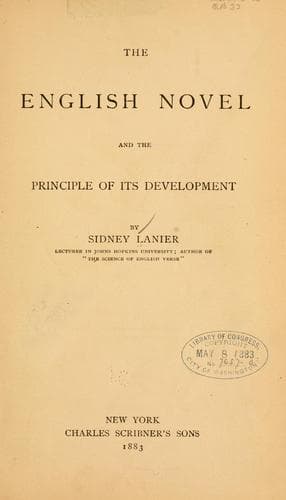
The English Novel and the Principle of its DevelopmentLanier, Sidney
History
The English Novel and the Principle of its Development
Lanier, Sidney
English fiction -- History and criticism
Now the sole purpose and outcome of the book lie in its answers to the
questions of these two young people. It does answer them, and answers
them satisfactorily. On the one hand, Gwendolen Harleth, in the course
of her married life, is several times thrown with Daniel Deronda; his
loftiness, his straightforwardness, his fervor, his frankness, his
general passion for whatsoever things are large and fine,--in a word,
his goodness--form a complete revelation to her. She suddenly
discovers that life is not only worth living, but that the possibility
of making one's life a good life invests it with a romantic interest
whose depth is infinitely beyond that of all the society-pleasures
which had hitherto formed her horizon. On the other hand, Daniel
Deronda discovers that he is a Jew by birth, and fired by the visions
of a fervent Hebrew friend, he resolves to devote his life and the
wealth that has fallen to him from various sources to the cause of
reëstablishing his people in their former Eastern home. Thus also for
him, instead of presenting the dreary doubt whether it is worth
living, life opens up a boundless and fascinating field for energies
of the loftiest kind.
Place then, clearly before your minds these two distinct strands of
story. One of these might be called _The Repentance of Gwendolen
Harleth_, and this occupies much the larger portion of the work. The
other might be called _The Mission of Daniel Deronda_. These two
strands are, as we have just seen, united into one artistic thread by
the organic purpose of the book which is to furnish a fair and
satisfactory answer to the common question over which these two young
protagonists struggle: "Is life worth living?"
Now the painting of this repentance of Gwendolen Harleth, the
development of this beautiful young aristocrat Daniel Deronda into a
great and strong man consecrated to a holy purpose: all this is done
with such skillful reproduction of contemporary English life, with
such a wealth of flesh-and-blood character, with an art altogether so
subtile, so analytic, yet so warm and so loving withal, that if I were
asked for the most significant, the most tender, the most pious and
altogether the most uplifting of modern books, it seems to me I should
specify _Daniel Deronda_.
Public-domain text, read in full here on John Shaqi.
Reviews
Reviews
No reviews yet
Be the first to share your thoughts on this work.
Elsewhere in the archive
Join the Discussion
Join the discussion
Sign in to leave a comment or review.
Sign InorCreate an account