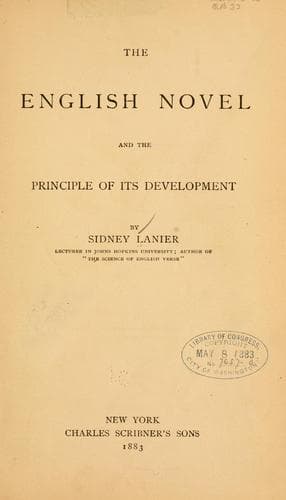
The English Novel and the Principle of its DevelopmentLanier, Sidney
History
The English Novel and the Principle of its Development
Lanier, Sidney
English fiction -- History and criticism
thought I could not render better service than by conducting our
analysis of _Daniel Deronda_ so as to make it embrace some of the most
common of the objections urged against that work. Let us recall in
largest possible outline the movement of _Daniel Deronda_. This can be
done in a surprisingly brief statement. The book really concerns two
people--one is Gwendolen Harleth, a beautiful English girl, brought up
with all those delicate tastes and accomplishments which we understand
when we think of the highest English refinement, wayward--mainly
because she has seen as yet no way that seemed better to follow than
her own--and ambitious, but evidently with that sacred discontent
which desires the best and which will only be small when its horizon
contains but small objects. The other main personage is Daniel
Deronda, who has been brought up as an Englishman of rank, has a
striking face and person, a natural love for all that is beautiful and
noble, a good sense that enables him to see through the banalities of
English political life and to shrink from involving his own existence
in such littleness, and who, after some preliminary account of his
youth in the earlier chapters, is placed before us early in the first
book as a young man of twenty who is seriously asking himself whether
life is worth living.
It so happens however that presently Gwendolen Harleth is found asking
herself the same question. Tempted by a sudden reverse of fortune, by
the chance to take care of her mother, and one must add by her own
desire--guilty enough in such a connection--for plenty of horses to
ride, and for all the other luxurious accompaniments which form so
integral a portion of modern English life; driven, too, by what one
must not hesitate to call the cowardliest shrinking from the name and
position of a governess; conciliated by a certain infinite appearance
of lordliness which in Grandcourt is mainly nothing more than a blasé
brutality which has exhausted desire, Gwendolen accepts the hand of
Grandcourt, quickly discovers him to be an unspeakable brute, suffers
a thousand deaths from remorse and is soon found--as is just
said--wringing her hands and asking if life is worth living.
Public-domain text, read in full here on John Shaqi.
Reviews
Reviews
No reviews yet
Be the first to share your thoughts on this work.
Elsewhere in the archive
Join the Discussion
Join the discussion
Sign in to leave a comment or review.
Sign InorCreate an account