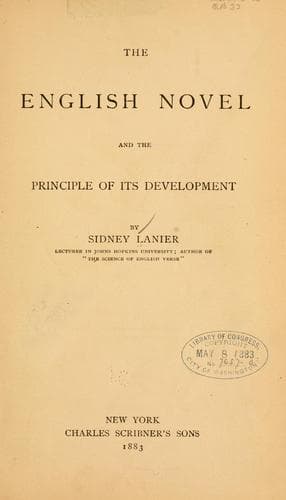
The English Novel and the Principle of its DevelopmentLanier, Sidney
History
The English Novel and the Principle of its Development
Lanier, Sidney
English fiction -- History and criticism
"We are not the first
Who with best meaning have incurred the worst.
For thee, oppressed king, am I cast down.
Shall we not see these daughters and these sisters?"
_Lear._--No, no, no, no! Come let's away to prison;
We two alone will sing like birds i' the cage;
When thou dost ask me blessing, I'll kneel down
And ask of thee forgiveness."
Here, clearly enough, is regret for his injury to Cordelia, but quite
as clearly, no general state of repentance; and in the very few other
words uttered by the old king before the play ends surely nothing
indicating such a state appears. Of all the instances suggested only
one involves anything like the process of character-change which I
have called a repentance, such as Gwendolen Harleth's for example; but
this one, unfortunately, is not drawn by Shakspeare: it is only
mentioned as having occurred. This is the repentance of Duke Frederick
in _As you Like it_. Just at the end of that play, when Orlando and
Rosalind, Oliver, and Celia and all the rest have unraveled all their
complications, and when everything that can be called plot in the play
is finished, the son of old Sir Rowland appears before the company in
the wood and calls out:
"Let me have audience for a word or two.
* * * *
Duke Frederick hearing how that every day
Men of great worth resorted to this forest
Addressed a mighty power
purposely to take
His brother here and put him to the sword,
And to the skirts of this wild wood he came,
Where meeting with an old religious man,
After some questions with him was converted
Both from his enterprise and from the world;
His crown bequeathing to his banished brother,
And all their lands restored to them again
That were with him exiled."
Here we have indeed a true repentance, but this is all we have of it;
the passage I have read contains the whole picture.
If we now go on and ask ourselves why these fascinating phenomena of
repentance, which George Eliot has treated with such success, never
engaged Shakspeare's energy, we come at the very first step upon a
limitation of the drama as opposed to the novel which, in the
strongest way, confirms the view I was at such pains to set forth in
my earlier lectures of that necessity for a freer form than the
dramatic, which arises from the more complete relations between modern
personalities and which has really developed the novel out of the
drama.
Public-domain text, read in full here on John Shaqi.
Reviews
Reviews
No reviews yet
Be the first to share your thoughts on this work.
Elsewhere in the archive
Join the Discussion
Join the discussion
Sign in to leave a comment or review.
Sign InorCreate an account