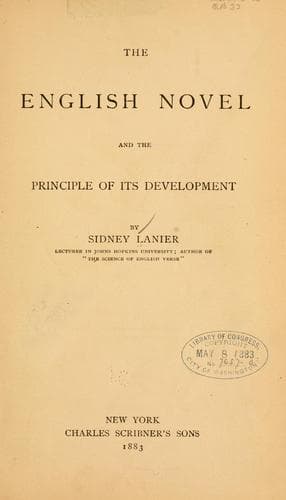
The English Novel and the Principle of its DevelopmentLanier, Sidney
History
The English Novel and the Principle of its Development
Lanier, Sidney
English fiction -- History and criticism
How, for instance, could Shakspeare paint the yeas and nays, the
twists, the turns, the intricacies of Gwendolen Harleth's thought
during the long weeks while she was debating whether she should accept
Grandcourt? The whole action of this drama, you observe, is confined
within the small round head of the girl herself. How could such action
be brought before the audience of a play? The only hope would be in a
prolonged soliloquy, for these are thoughts which no young woman would
naturally communicate to any one; but what audience could stand so
prolonged a soliloquy, even if any character could be found in whom it
would be natural? And sometimes, too, the situation is so subtly
complex that Gwendolen is soliloquizing in such a manner that we, the
audience, hear her while Grandcourt, who is standing by, does not.
"I used to think archery was a great bore," Grandcourt began. He
spoke with a fine accent, but with a certain broken drawl, as of
a distinguished personage with a distinguished cold in his chest.
"Are you converted to-day?" said Gwendolen.
(Pause, during which she imagined various degrees and modes of
opinion about herself that might be entertained by Grandcourt.)
"Yes, since I saw you shooting. In things of this sort one
generally sees people missing and simpering."
"And do you care about the turf? or is that among the things you
have left off?"
(Pause, during which Gwendolen thought that a man of extremely
calm cold manners might be less disagreeable as a husband than
other men, and not likely to interfere with his wife's
preferences.)
"You would perhaps like tiger-hunting or pig-sticking. I saw some
of that for a season or two in the East. Everything here is poor
stuff after that."
"You are fond of danger then?"
(Pause, during which Gwendolen speculated on the probability that
the men of coldest manners were the most adventurous, and felt
the strength of her own insight, supposing the question had to be
decided.)
"One must have something or other. But one gets used to it."
"I begin to think I am very fortunate, because everything is new
to me; it is only that I can't get enough of it. I am not used to
anything except being dull, which I should like to leave off as
you have left off shooting."
(Pause, during which it occurred to Gwendolen that a man of cold
and distinguished manners might possibly be a dull companion; but
on the whole, the thought that most persons were dull, and that
she had not observed husbands to be companions.)
"Why are you dull?"
"This is a dreadful neighborhood, there is nothing to be done in
it. That is why I practised my archery."
Public-domain text, read in full here on John Shaqi.
Reviews
Reviews
No reviews yet
Be the first to share your thoughts on this work.
Elsewhere in the archive
Join the Discussion
Join the discussion
Sign in to leave a comment or review.
Sign InorCreate an account