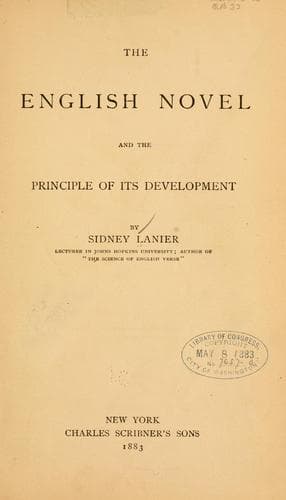
The English Novel and the Principle of its DevelopmentLanier, Sidney
History
The English Novel and the Principle of its Development
Lanier, Sidney
English fiction -- History and criticism
possible as a marriage between a Gwendolen Harleth and a Grandcourt;
this was enough to irritate even the thickest-skinned Philistine, and
this George Eliot's book showed with a terrible conclusiveness. Yet
the showing was made so daintily and with so light a hand that, as I
have said, current society did not know, and has not yet recognized
where or how the wound was. We have all read of the miraculous sword
in the German fable whose blade was so keen that when, upon a certain
occasion, its owner smote a warrior with it from crown to saddle, the
warrior nevertheless rode home and was scarcely aware he had been
wounded until, upon his wife opening the door, he attempted to embrace
her and fell into two pieces. Now, as I said, just as _Daniel Deronda_
made people feel uncomfortable by even vaguely revealing a sharp
truth--so, a prig, so far as I can make out, is a person whose
goodness is so genuine, essential and ever-present that all ungenuine
people have a certain sense of discomfort when brought in contact with
it. If the prig-hater be questioned he will not deny the real goodness
of the _Daniel Deronda_ people; he dare not--no one in this age
dare--to wish explicitly that Mirah and Daniel Deronda might be less
good; but as nearly as anything definite can be obtained what he
desires is that the prig should be good in some oily and lubricative
way so as not to jar the nerves of those who are less good. Conform,
conform! seems to be the essential cry of the prig-haters; if you go
to an evening party you wear your dress coat and look like every other
man; but if your goodness amounts to a hump, a deformity, we do not
ask you to cut it off, but at least pad it; if every one grows as big
as you we shall have to enlarge all our drawing-rooms and society will
be disorganized. In short, the cry against the prig turns out to be
nothing more than the old claim for conformity and the conventional.
For one, I never hear these admonitions to conformity without
recalling a comical passage of Tom Hood's in which the fellows of a
Zoological society propose to remedy the natural defects of animal
morphology, such as the humps of dromedaries and the overgrowth of
hair upon lions so as to bring all the grotesqueness of the animal
creation into more conformity with conventional ideas of proportion.
The passage occurs in a pretended report from the keeper of the
animals to the President of the society. After describing the
condition of the various beasts the keeper proceeds:
Public-domain text, read in full here on John Shaqi.
Reviews
Reviews
No reviews yet
Be the first to share your thoughts on this work.
Elsewhere in the archive
Join the Discussion
Join the discussion
Sign in to leave a comment or review.
Sign InorCreate an account