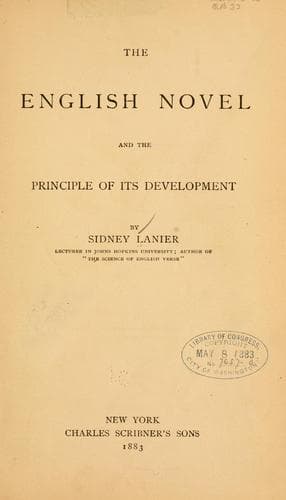
The English Novel and the Principle of its DevelopmentLanier, Sidney
History
The English Novel and the Principle of its Development
Lanier, Sidney
English fiction -- History and criticism
Upon bringing together, however, all the objections which have been
urged against _Daniel Deronda_, I think they may be classified and
discussed under two main heads. First it is urged that Daniel Deronda
and Mirah--and even Gwendolen Harleth, after her change of spirit--are
all prigs; secondly, it is urged that the moral purpose of the book
has overweighted the art of it, that what should have been pure nature
and beauty have been obscured by didacticism, thus raising the whole
question of Art for Art's sake which has so mournfully divided the
modern artistic world. This last objection, opening, as it does, the
whole question of how far fervent moral purpose injures the work of
the true artist, is a matter of such living importance in the present
state of our art,--particularly of our literary art; it so completely
sums up all these contributory items of thought which have been
gradually emerging in these lectures regarding the growth of human
personality together with the correlative development of the novel:
and the discussions concerning it are conducted upon such small planes
and from such low and confusing points of view that I will ask to
devote my next lecture to a faithful endeavor to get all the light
possible upon the vexed matter of Art for Art's sake, and to showing
how triumphantly George Eliot's _Daniel Deronda_ seems to settle that
entire debate with the most practical of answers.
Meantime in discussing the other class of objections which we managed
to generalize, to wit that the three main characters in _Daniel
Deronda_ are prigs, a serious difficulty lies in the impossibility of
learning from these objectors exactly what _is_ a prig. And I confess
I should be warned off from any attempt at discussion by this initial
difficulty if I did not find great light thrown on the subject by
discovering that the two objections of prig-ism and that of
didacticism already formulated are really founded upon the same
cunning weakness in our current culture. The truth is George Eliot's
book _Daniel Deronda_, is so sharp a sermon that it has made the whole
English contemporary society uncomfortable. It is curious and
instructive to see how unable all the objectors have been to put their
fingers upon the exact source of this discomfort; so that in their
bewilderment one lays it to prig-ism, another to didacticism, and so
on. That a state of society should exist in which such a piece of
corruption as Grandcourt should be not only the leader but the
crazing fascination and ideal of the most delicate and fastidious
young women in that society; that a state of society should exist in
which those pure young girls whom George Eliot describes as "the
delicate vessels in which man's affections are hoarded through the
ages," should be found manœuvring for this Grandcourt infamy,
plotting to be Grandcourt's wife instead of flying from him in horror;
that a state of society should exist in which such a thing was
Public-domain text, read in full here on John Shaqi.
Reviews
Reviews
No reviews yet
Be the first to share your thoughts on this work.
Elsewhere in the archive
Join the Discussion
Join the discussion
Sign in to leave a comment or review.
Sign InorCreate an account