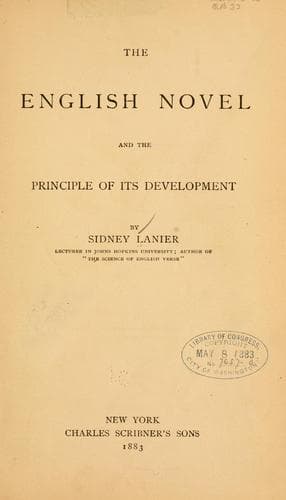
The English Novel and the Principle of its DevelopmentLanier, Sidney
History
The English Novel and the Principle of its Development
Lanier, Sidney
English fiction -- History and criticism
In the last lecture we obtained a view of George Eliot's _Daniel
Deronda_ as containing two distinct stories, one of which might have
been called _The Repentance of Gwendolen Harleth_, and the other, _The
Mission of Daniel Deronda_; and we generalized the principal
objections against the work into two: namely, that the main characters
were prigs, and that the artistic value of the book was spoiled by its
moral purpose. In discussing the first of these objections we found
that probably both of them might be referred to a common origin; for
examination of precisely what is meant by a prig revealed that he is a
person whose goodness is so downright, so unconforming and so reduced
that it makes the mass of us uncomfortable. Now there can be no
question that so far as the charge of being overloaded with moral
purposes is brought against _Daniel Deronda_, as distinguished from
George Eliot's other works, it is so palpably contrary to all facts in
the case that we may clearly refer it to some fact outside the case:
and I readily find this outside fact in that peculiar home-thrust of
the moral of _Daniel Deronda_ which has rendered it more tangible than
that of any preceding work which concerned time past. You will
remember we found that it was only in _Daniel Deronda_, written in
1876, after thirty years of study and of production, that George Eliot
allowed herself to treat current English society; you will remember
too, how we found that this first treatment revealed among other
things a picture of an unspeakable brute, Grandcourt, throned like an
Indian lama above the multitude, and receiving with a blasé stare,
the special adoration of the most refined young English girls; a
picture which made the worship of the golden calf or the savage dance
around a merely impotent wooden idol, fade into tame blasphemy. No man
could deny the truth of the picture; the galled jade was obliged to
wince; this time it was _my_ withers that were wrung. Thus the moral
purpose of _Daniel Deronda_ which is certainly beyond all comparison
less obtrusive than that of any other book written by George Eliot,
grew by its very nearness, out of all perspective. Though a mere gnat,
it sat on the very eyelash of society and seemed a monster.
Public-domain text, read in full here on John Shaqi.
Reviews
Reviews
No reviews yet
Be the first to share your thoughts on this work.
Elsewhere in the archive
Join the Discussion
Join the discussion
Sign in to leave a comment or review.
Sign InorCreate an account