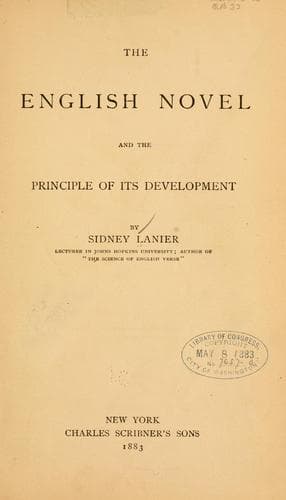
The English Novel and the Principle of its DevelopmentLanier, Sidney
History
The English Novel and the Principle of its Development
Lanier, Sidney
English fiction -- History and criticism
In speaking of George Eliot's earlier stories I was at pains to show
how explicitly she avowed their moral purpose; in _Amos Barton_, in
_Janet's Repentance_, in _Adam Bede_, everywhere there is the fullest
avowal of didacticism; on almost every other page one meets those
direct appeals from the author in her own person to the reader, in
which George Eliot indulged more freely than any novelist I know,
enforcing this or that moral view in plain terms of preaching. But it
curiously happens that even these moral 'asides' are conspicuously
absent in _Daniel Deronda_: the most cursory comparison of it in this
particular with _Adam Bede_, for example, reveals an enormous
disproportion in favor of _Deronda_ as to the weight of this
criticism. Yet people who had enthusiastically accepted and extolled
_Adam Bede_, with all its explicitly moralizing passages and its
professedly preaching characters, suddenly found that _Daniel Deronda_
was intolerably priggish and didactic. But resting then on the facts
in the case--easily possible by comparing _Daniel Deronda_ with any
previous work--as to show how this censure of didacticism loses all
momentum as against this particular book; let us advance to the more
interesting, because more general, fact that many people--some in
great sincerity--have preferred this censure against all of George
Eliot's work and against all didactic novels in general. The objection
involved many shades of opinion, and is urged with the most diverse
motives and manner. At one extreme we have the _Saturday Review_
growling that the office of the novelist is to amuse, never to
instruct, that George Eliot, in seeking the latter has even forfeited
the former, and that _Daniel Deronda_ neither amuses nor instructs;
whereupon George Eliot is derisively bid, in substance, to put on the
cap and bells again, and leave teaching to her betters; with a voice,
by the way, wondrously like that with which the _Edinburgh Review_
some years ago cried out to our adorable John Keats, "Back to your
gallipots, young man." From this extreme we have all shades of opinion
to that vague and moderate apprehension much current among young
persons influenced by a certain smart sound in the modern French
phrase _l'Art pour l'Art_, or by the German nickname of
"tendency-books," that a moral intention on the part of an artist is
apt to interfere with the naturalness or intrinsic beauty of his work;
that in art the controlling consideration must always be artistic
beauty; and that artistic beauty is not only distinct from, but often
opposed to moral beauty. Now, to discuss this question _a priori_: to
go forward and establish an æsthetic basis for beauty, involving an
examination which must range from Aristotle to Kant and Burke and Mr.
Grant Allen's physiological theories, would require another course of
lectures quite as long as that which is now ending; so that all I can
hope to do is but to throw, if I can, some light upon this question.
Public-domain text, read in full here on John Shaqi.
Reviews
Reviews
No reviews yet
Be the first to share your thoughts on this work.
Elsewhere in the archive
Join the Discussion
Join the discussion
Sign in to leave a comment or review.
Sign InorCreate an account