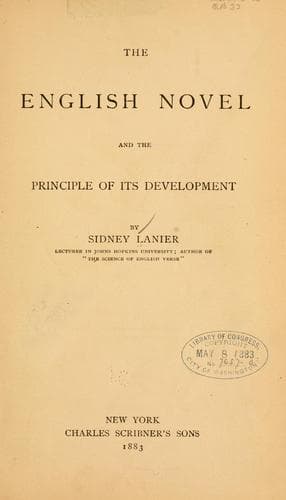
The English Novel and the Principle of its DevelopmentLanier, Sidney
History
The English Novel and the Principle of its Development
Lanier, Sidney
English fiction -- History and criticism
And, so to proceed immediately to that work with some system: permit
me to recall to you in the first place that the requirement has been
from time immemorial that wherever there is contest as between
artistic and moral beauty, unless the moral side prevail, all is lost.
Let any sculptor hew us out the most ravishing combination of tender
curves and spheric softness that ever stood for woman; yet if the lip
have a certain fulness that hints of the flesh, if the brow be
insincere, if in the minutest particular the physical beauty suggest a
moral ugliness, that sculptor--unless he be portraying a moral
ugliness for a moral purpose--may as well give over his marble for
paving-stones. Time, whose judgments are inexorably moral, will not
accept his work. For indeed we may say that he who has not yet
perceived how artistic beauty and moral beauty are convergent lines
which run back into a common ideal origin, and who therefore is not
afire with moral beauty just as with artistic beauty--that he, in
short, who has not come to that stage of quiet and eternal frenzy in
which the beauty of holiness and the holiness of beauty mean one
thing, burn as one fire, shine as one light, within him;--he is not
yet the great artist. Here it is most instructive to note how fine and
beautiful souls of time appear after awhile to lose all sense of
distinction between these terms, Beauty, Truth, Love, Wisdom,
Goodness, and the like. Hear some testimony upon this point: this is a
case for witnesses. Let us call first Keats. Keats does not hesitate
to draw a moral even from his Grecian Urn, and even in the very
climacteric of his most "high sorrowful" song; and that moral effaces
the distinction between truth and beauty. "Cold pastoral" he cries, at
the end of the Ode on a Grecian Urn.
"When old age shall this generation waste,
Thou shalt remain in midst of other woe
Than ours, a friend to man to whom thou say'st
Beauty is truth, truth, beauty,--that is all
Ye know on earth, and all ye need to know."
Again, bearing in mind this identity of truth and beauty in Keats'
view, observe how Emerson, by strange turns of thought, subtly refers
both truth and beauty to a common principle of the essential relation
of each thing to all things in the universe. Here are the beginning
and end of Emerson's poem called _Each and All_:
"Little thinks in the field yon red-cloaked clown
Of thee from the hill-top looking down;
The sexton tolling his bell at noon
Deems not that great Napoleon
Stops his horse and lists with delight
While his files sweep 'round Alpine height;
Nor knowest thou what argument
Thy life to thy neighbor's creed has lent.
All are needed by each one;
Nothing is fair or good alone."
Public-domain text, read in full here on John Shaqi.
Reviews
Reviews
No reviews yet
Be the first to share your thoughts on this work.
Elsewhere in the archive
Join the Discussion
Join the discussion
Sign in to leave a comment or review.
Sign InorCreate an account