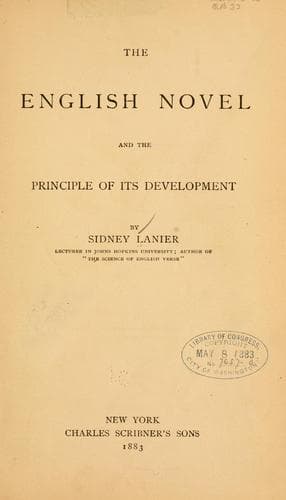
The English Novel and the Principle of its DevelopmentLanier, Sidney
History
The English Novel and the Principle of its Development
Lanier, Sidney
English fiction -- History and criticism
_Luc._--False Heart--thou thinkest more!
Thou canst not choose but think it, that I stand
Most absolute in beauty. As yourselves
Were fashioned very good at best, so we
Sprang very beauteous from the creant Word
Which thrilled behind us, God Himself being moved
When that august mark of a perfect shape,--
His dignities of sovran angel-hood,--
Swept out into the universe,--divine
With thunderous movements, earnest looks of gods,
And silver-solemn clash of cymbal-wings!
Whereof was I, in motion, and in form,
A part not poorest. And yet,--yet, perhaps,
This beauty which I speak of is not here,
As God's voice is not here, nor even my crown
I do not know. What is this thought or thing
Which I call beauty? is it thought or thing?
Is it a thought accepted for a thing?
Or both? or neither?--a pretext--a word?
Its meaning flutters in me like a flame
Under my own breath: my perceptions reel
For evermore around it, and fall off,
As if, it, too, were holy.
_Eve._--Which it is.
_Adam._--The essence of all beauty, I call love.
The attribute, the evidence, the end,
The consummation to the inward sense,
Of beauty apprehended from without,
I still call love. As form, when colorless,
Is nothing to the eye,--that pine-tree there,
Without its black and green, being all a blank,--
So, without love, is beauty undiscerned,
In man or angel. Angel! rather ask
What love is in thee, what love moves to thee,
And what collateral love moves on with thee;
Then shalt thou know if thou art beautiful.
_Luc._--Love! what is love? I lose it. Beauty and love
I darken to the image. Beauty--love!
Let us now carry forward this connection between love and beauty in
listening to a further testimony of Emerson's in a poem called _The
Celestial Love_, where, instead of identifying _beauty_ and _truth_
with Keats, we find him making _love_ and _truth_ to be one.
"Love's hearts are faithful, but not fond,
Bound for the just but not beyond;
Not glad, as the low-loving herd,
Of self in other still preferred
But they have heartily designed
The benefit of broad mankind
And they serve men austerely,
After their own genius, clearly.
Without a false humility;
For this is love's nobility,--
Not to scatter bread and gold,
Goods and raiment bought and sold;
But to hold fast his simple sense,
And speak the speech of innocence,
And with hand, and body, and blood,
To make his bosom-counsel good.
For he that feeds men serveth few;
He serves all that dares be true."
Public-domain text, read in full here on John Shaqi.
Reviews
Reviews
No reviews yet
Be the first to share your thoughts on this work.
Elsewhere in the archive
Join the Discussion
Join the discussion
Sign in to leave a comment or review.
Sign InorCreate an account