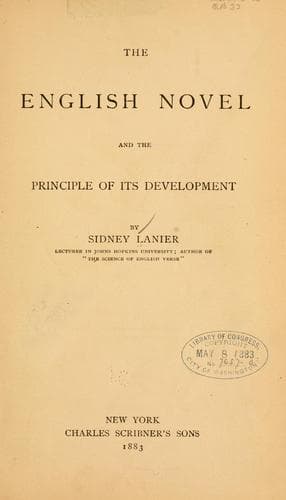
The English Novel and the Principle of its DevelopmentLanier, Sidney
History
The English Novel and the Principle of its Development
Lanier, Sidney
English fiction -- History and criticism
And in connection with these lines:--
"Not glad, as the low-loving herd,
Of self in other still preferred,"
I must here beg you to observe the quite incalculable advance in the
ideal of love here presented by Emerson, and the ideal which was
thought to be the crown and boast of the classic novel a hundred years
ago, and which is still pointed to with exultation by thoughtless
people. This ideal, by universal voice was held to have been
consummated by Fielding in his character of Squire Allworthy, in the
famous novel, _Tom Jones_. And here it is: we have a dramatic
presentation of Squire Allworthy early on a May morning, pacing the
terrace before his mansion which commanded a noble stretch of country,
and then Fielding glows thus: "In the full blaze of his majesty up
rose the sun, than which one object alone in this lower creation could
be more glorious, and that Mr. Allworthy himself presented--a human
being replete with benevolence, meditating in what manner he might
render himself most acceptable to his Creator by doing most good to
his creatures." Here Mr. Allworthy's benevolence has for its object to
render himself most acceptable to his Creator; his love, in other
words, is only another term for increasing his account in the Bank of
Heaven; a perfect example, in short, of that love of the low-loving
herd which is self in other still preferred.
But now let me once more turn the tube and gain another radiant
arrangement of these kaleidoscopic elements, beauty and love and the
like. In Emerson's poem called "Beauty," which must be distinguished
from the "Ode to Beauty," the relation between love and beauty takes
this turn: "Seyd," he says, "chased beauty
"Everywhere,
In flame, in storm, in clouds of air.
He smote the lake to feed his eye
With the beryl beam of the broken wave;
He flung in pebbles well to hear
The moment's music which they gave.
Oft pealed for him a lofty tone
From nodding pole and belting zone.
He heard a voice none else could hear
From centred and from errant sphere.
The quaking earth did quake in rhyme,
Seas ebbed and flowed in epic chime,
In dens of passion, pits of woe,
He saw strong Eros struggling through,
To sum the doubt and solve the curse
And beam to the bounds of the universe.
While thus to love he gave his days
In loyal worship, scorning praise,"
(where, you observe, love is substituted for beauty, as that to which
he gave his days, in the most naive _assumption_ that the one involved
the other.)
"While thus to love he gave his days
In loyal worship, scorning praise,
How spread their lures for him in vain
Thieving ambition and paltering gain!
He thought it happier to be dead,
To die for Beauty,--than live for bread."
Public-domain text, read in full here on John Shaqi.
Reviews
Reviews
No reviews yet
Be the first to share your thoughts on this work.
Elsewhere in the archive
Join the Discussion
Join the discussion
Sign in to leave a comment or review.
Sign InorCreate an account