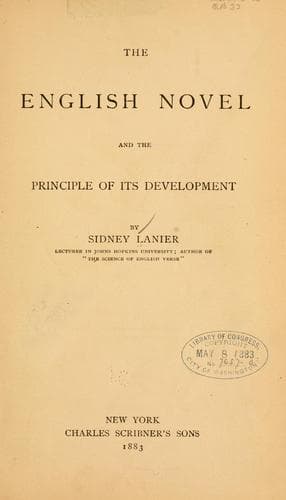
The English Novel and the Principle of its DevelopmentLanier, Sidney
History
The English Novel and the Principle of its Development
Lanier, Sidney
English fiction -- History and criticism
But now secondly, as to the influence of moral purpose in art: we have
been in the habit, as you will remember, of passing at the earliest
possible moment from abstract discussion to the concrete instance; and
if we now follow that course and inquire,--not whether moral purpose
_may_ interfere with artistic creation,--but whether moral purpose
_has_ interfered with artistic creation, as matter of fact, in the
works of those whom the ages have set in the highest heaven of art, we
get a verdict which seems to leave little room for question. At the
beginning we are met with the fact that the greatest work has always
gone hand in hand with the most fervent moral purpose. For example,
the most poetical poetry of which we know anything is that of the
author of Job, and of David and his fellow psalm-writers. I have used
the expression "most poetical" here with design; for regarded as pure
literature these poems in this particular of poeticalness, of pure
spirituality, lift themselves into a plane not reached by any others.
A single fact in proof of this exceeding poeticalness will suffice: it
is the fact that these poems alone, of all ever written, bear
translation from one language into another without hurt. Surely this
can be said of no other poetic work. If we strike away all allowances
of amateurishness and good fellowship and judge with the
uncompromising truth of the pious artist; how pitiful is Homer as he
appears in even Pope's English; or how subtly does the simplicity of
Dante sink into childishness even with Mr. Longfellow interpreting; or
how tedious and flat fall the cultured sentences of Goethe even in
Taylor's version, which has by many been declared the most successful
translation ever made, not only of _Faust_ but of any foreign poem;
nay, how completely the charm of Chaucer exhales away even when
redacted merely from an older dialect into a later one, by hands so
skillful as those of Dryden and Wordsworth.
Now, it is words and their associations which are untranslatable, not
ideas; there is no _idea_, whether originating in a Hebrew, Greek or
other mind, which cannot be adequately produced as idea in English
words; the reason why Shakspeare and Dante are practically
untranslatable is that recognizing how every word means more than
itself to its native users,--how every word is like the bright head of
a comet drawing behind it a less luminous train of vague associations
which are associations only to those who have used such words from
infancy,--Shakspeare and Dante, I say, have used this fact, and have
constructed poems which necessarily mean more to native hearers than
they can possibly mean to any foreign ear.
But this Hebrew poetry which I have mentioned is so purely composed of
ideas which are universal, essential, fundamental to the personality
of man, instantly recognizable by every soul of every race,--that they
remain absolutely great, absolutely artistic, in whatever language
they are couched.
Public-domain text, read in full here on John Shaqi.
Reviews
Reviews
No reviews yet
Be the first to share your thoughts on this work.
Elsewhere in the archive
Join the Discussion
Join the discussion
Sign in to leave a comment or review.
Sign InorCreate an account