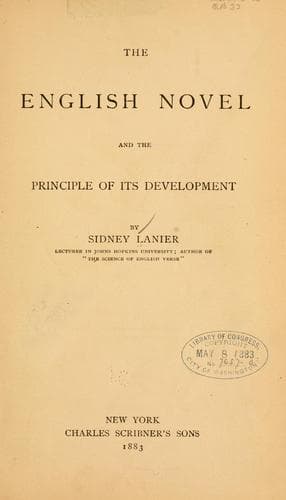
The English Novel and the Principle of its DevelopmentLanier, Sidney
History
The English Novel and the Principle of its Development
Lanier, Sidney
English fiction -- History and criticism
George Eliot has somewhere called this word love a word-of-all-work.
If with another turn I add to these testimonies one from Swedenborg,
in which this same love--which we have just seen to be beauty--which
beauty we just before saw to be truth--is now identified with
_wisdom_: we prove the justice of George Eliot's phrase. In Section X
of his work on the Divine Providence Swedenborg says: "The good of
love is not good any further than it is united to the truth of wisdom;
and the truth of wisdom is not truth any further than it is united to
the good of love;" and he continues in section XIII: "Now because
truth is from good, as wisdom is from love, therefore both taken
together are called love or good; for love in its form is wisdom, and
good in its form is truth."
And finally does not David practically confirm this view where, in
Psalm CXIX. he involves the love of the law of God with wisdom in the
verse: "I understand more than the ancients because I keep thy
precepts?"
But I grieve that there is no time to call more witnesses; for I love
to assemble these lofty spirits and hear them speak upon one topic. Is
it not clear that in the minds of these serious thinkers truth,
beauty, wisdom, goodness, love, appear as if they were but orators of
one and the same essential God?
And if this be true cannot one say with authority to the young
artist,--whether working in stone, in color, in tones or in
character-forms of the novel: so far from dreading that your moral
purpose will interfere with your beautiful creation, go forward in the
clear conviction that unless you are suffused--soul and body, one
might say--with that moral purpose which finds its largest expression
in love--that is, the love of all things in their proper
relation--unless you are suffused with this love do not dare to meddle
with beauty, unless you are suffused with beauty, do not dare to
meddle with love, unless you are suffused with truth, do not dare to
meddle with goodness,--in a word, unless you are suffused with beauty,
truth, wisdom, goodness _and_ love, abandon the hope that the ages
will accept you as an artist.
Of course I leave out of view here all that field of artistic activity
which is merely neutral, which is--not immoral but--merely _un_moral.
The situations in Scott's novels for instance do not in general put us
upon any moral question as between man and man. Or when our own Mr.
Way paints his luminous bunches of grapes, one of which will feed the
palates of a thousand souls though it is never eaten, and thus shows
us how Art repeats the miracle of the loaves and fishes, feeding the
multitude and leaving more of the original provision than was at
first; we have most delightful unmoral art. This is not only
legitimate, but I think among the most beneficent energies of art; it
rests our hearts, it gives us holiday from the Eternal Debate, it
re-creates us for all work.
Public-domain text, read in full here on John Shaqi.
Reviews
Reviews
No reviews yet
Be the first to share your thoughts on this work.
Elsewhere in the archive
Join the Discussion
Join the discussion
Sign in to leave a comment or review.
Sign InorCreate an account