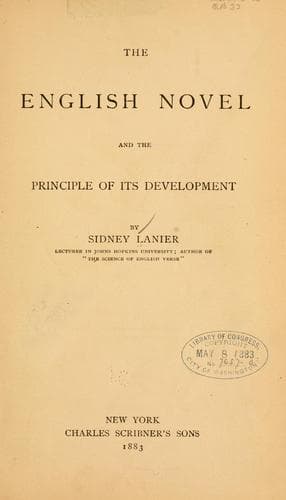
The English Novel and the Principle of its DevelopmentLanier, Sidney
History
The English Novel and the Principle of its Development
Lanier, Sidney
English fiction -- History and criticism
Then did He see it and declare it;
He prepared it, yea, and searched it out.
And unto man He said: "Behold the fear of the Lord, that is wisdom;
and to depart from evil is understanding."
Here it is apparent enough that the moral purpose with which these
writers were beyond all question surcharged, instead of interfering
with the artistic value of their product, has spiritualized the art of
it into an intensity which burns away all limitations of language and
sets their poems as indestructible monuments in the hearts of the
whole human race.
If we descend to the next rank of poetry I have only to ask you to
observe how, in Shakspeare, just as the moral purpose becomes loftier
the artistic creations become lovelier. Compare, for example, the
forgiveness and reconciliation group of plays as they have been
called, _Winter's Tale_, _Henry VIII_, and _The Tempest_, (which must
have been written late in Shakspeare's life when the moral beauty of
large forgiveness seems to have taken full possession of his fancy,
and when the moral purpose of displaying that beauty to his fellow-men
seemed to have reigned over his creative energy): compare, I say,
these plays with earlier ones, and it seems to me that all the main
creations are more distinctly artistic, more spiritually beautiful,
lifted up into a plane of holy ravishment which is far above that of
all the earlier plays. Think of the dignity and endless womanly
patience of Hermione, of the heavenly freshness and morning quality of
Perdita, of the captivating roguery of Autolycus, in _Winter's Tale_;
of the colossal forgiveness of Queen Katherine in _Henry VIII_, of the
equally colossal pardon of Prospero, of the dewy innocence of Miranda,
of the gracious and graceful ministrations of Ariel, of the
grotesqueries of Caliban and Trinculo, of the play of ever-fresh
delights and surprises which make the drama of _The Tempest_ a lone
and music-haunted island among dramas! Everywhere in these latter
plays I seem to feel the brooding of a certain sanctity which breathes
out of the larger moral purpose of the period.
Leaving these illustrations, for which time fails, it seems to me that
we have fairly made out our case against these objections if, after
this review of the connection between moral purpose and artistic
creation we advance thirdly to the fact--of which these objectors seem
profoundly oblivious--that the English novel at its very beginning
announces itself as the vehicle of moral purposes. You will remember
that when discussing Richardson and Fielding, the first English
novelists, I was at pains to show how carefully they sheltered their
works behind the claim of this very didacticism. Everywhere in
_Pamela_, _Clarissa Harlowe_, _Tom Jones_, in the preface, sometimes
in the very title-page, it is ostentatiously set up that the object of
the book is to improve men's _moral_ condition by setting before them
plain examples of vice and virtue.
Public-domain text, read in full here on John Shaqi.
Reviews
Reviews
No reviews yet
Be the first to share your thoughts on this work.
Elsewhere in the archive
Join the Discussion
Join the discussion
Sign in to leave a comment or review.
Sign InorCreate an account