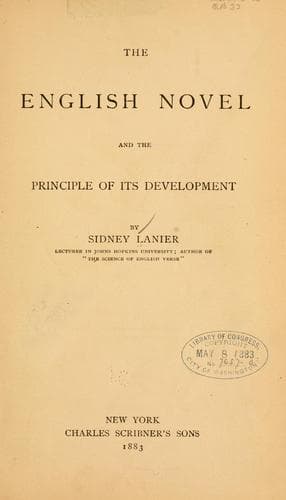
The English Novel and the Principle of its DevelopmentLanier, Sidney
History
The English Novel and the Principle of its Development
Lanier, Sidney
English fiction -- History and criticism
Passing by, therefore, the absurdity of the statement that the proper
office of the novelist is to amuse, and that when George Eliot
pretended to do more, and to instruct, she necessarily failed to do
either; it is almost as odd to find that the very objectors who urge
the injurious effect of George Eliot's moral purpose upon her work are
people who swear by Richardson and Fielding, utterly forgetting that
if moral purpose is a detriment to _Daniel Deronda_, it is simply
destruction to _Clarissa Harlowe_ and _Tom Jones_.
And lastly upon this point, when I think of the crude and hasty
criticism which confines this moral purpose in _Daniel Deronda_ to the
pushing forward of Deronda's so-called religious patriotism in
endeavoring to re-establish his people in the ancient seat of the
Hebrews,--a view which I call crude and hasty because it completely
loses sight of the much more prominent and important moral purpose of
the book, namely, the setting forth of Gwendolen Harleth's repentance;
when, I say, I hear these critics not only assume that Deronda's
mission is _the_ moral purpose of this book, but even belittle that by
declaring that George Eliot's enthusiasm for the rehabilitation of the
Jews must have been due to a chance personal acquaintance of hers with
some fervid Jew who led her off into these chimerical fancies; and
when, I find this tone prevailing not only with the Philistines, but
among a great part of George Eliot's otherwise friends and lovers:
then I am in a state of amazement which precludes anything like
critical judgment on my part. As for me, no Jew--not even the poorest
shambling clothes-dealer in Harrison street--but startles me
effectually out of this work-a-day world: when I look upon the face
of a Jew, I seem to receive a message which has come under the whole
sea of time from the further shore of it: this wandering person, who
without a home in any nation has yet made a literature which is at
home in every nation, carries me in one direction to my mysterious
brethren, the cavemen and the lake dwellers, in the other direction to
the carpenter of Bethlehem, climax of our race. And now, to gather
together these people from the four ends of the earth, to rehabilitate
them in their thousand-fold consecrated home after so many ages of
wandering, to re-make them into a homologous nation at once the newest
and the oldest upon the earth, to endow the 19th Century with that
prodigious momentum which all the old Jewish fervor and spirituality
and tenacity would acquire in the backward spring from such long ages
of restraint and oppression, and with the mighty accumulation of
cosmopolitan experiences; the bare suggestion would seem enough to
stir the blood of the most ungentle Gentile.
But I must hasten to complete the account of George Eliot's personal
existence which we suspended at the point where she had come to London
in 1851.
Public-domain text, read in full here on John Shaqi.
Reviews
Reviews
No reviews yet
Be the first to share your thoughts on this work.
Elsewhere in the archive
Join the Discussion
Join the discussion
Sign in to leave a comment or review.
Sign InorCreate an account