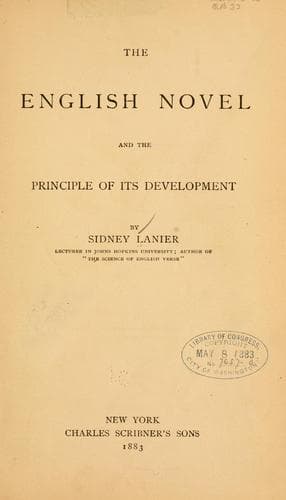
The English Novel and the Principle of its DevelopmentLanier, Sidney
History
The English Novel and the Principle of its Development
Lanier, Sidney
English fiction -- History and criticism
As the mind runs along these brief phrases in which I have with a
purposed brevity endeavored to flash the whole woman before you, and
as you supplement that view with this rapid summary of her literary
product,--the details of fact seem to bring out the extraordinary
nature of this woman's endowment in such a way that to add any general
eulogium would be necessarily to weaken the picture. There is but one
fact remaining so strong and high as not to be liable to this
objection, which seems to me so characteristic that I cannot do better
than close this study with it. During all her later life the central
and organic idea which gave unity to her existence was a burning love
for her fellow-men. I have somewhere seen that in conversation she
once said to a friend: "What I look to is a time when the impulse to
help our fellows shall be as immediate and as irresistible as that
which I feel to grasp something firm if I am falling," and the
narrator of this speech adds that at the end of it she grasped the
mantel-piece as if actually saving herself from a fall, with an
intensity which made the gesture most eloquent.
You will observe that of the two commandments in which the Master
summed up all duty and happiness--namely, to love the Lord with all
our heart, and to love our neighbor as ourself, George Eliot's whole
life and work were devoted to the exposition of the latter. She has
been blamed for devoting so little attention to the former; as for me,
I am too heartily grateful for the stimulus of human love which
radiates from all her works to feel any sense of lack or regret. This,
after all--the general stimulus along the line of one's whole
nature--is the only true benefit of contact with the great. More than
this is hurtful. Now a days, you do not want an author to tell you how
many times a day to pray, to prescribe how many inches wide shall be
the hem of your garment. This the Master never did; too well He knew
the growth of personality which _would_ settle these matters, each for
itself; too well He knew the subtle hurt of all such violations of
modern individualism; and after our many glimpses of the heartiness
with which George Eliot recognized the fact and function of human
personality one may easily expect that she never attempted to teach
the world with a rule and square, but desired only to embody in living
forms those prodigious generalizations in which the Master's
philosophy, considered purely as a philosophy, surely excelled all
other systems.
Public-domain text, read in full here on John Shaqi.
Reviews
Reviews
No reviews yet
Be the first to share your thoughts on this work.
Elsewhere in the archive
Join the Discussion
Join the discussion
Sign in to leave a comment or review.
Sign InorCreate an account