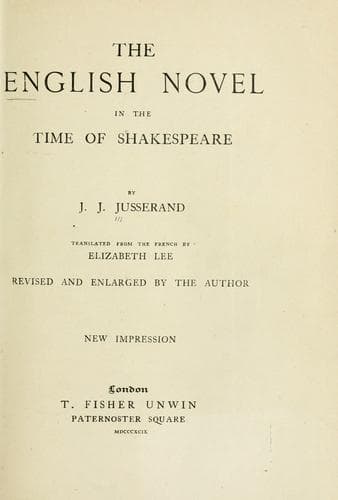
The English Novel in the Time of ShakespeareJusserand, J. J. (Jean Jules)
History
The English Novel in the Time of Shakespeare
Jusserand, J. J. (Jean Jules)
English fiction -- Early modern, 1500-1700 -- History and criticism
Ford's earliest and most characteristic work was called "Parismus, the
renowned prince of Bohemia ... conteining his noble battailes fought
against the Persians ... his love to Laurana ... and his straunge
adventures in the desolate Iland," &c., &c.[148] As the title informs us
there are loves and wars in this romance, deeds of valour and of
sorcery, there are pageants and enchanters. The adventures take place in
purely imaginary lands, which the author is pleased to call Bohemia,
Persia, &c., but which might have been as well baptized Tartary or
Mongolia. The manners and costumes, however, when there is an attempt at
describing them, are purely Elizabethan. There are masques such as were
shown at court in Shakespeare's time, and during one such fete, as in
"Romeo and Juliet," Parismus for the first time declares his love to
Laurana: "The maskers entred in this sort: first entred two torch
bearers, apparelled in white satten, beset with spangles of gold, after
whom followed two Eunuches, apparelled all in greene, playing on two
instruments, then came Parismus attired all in carnation satten ... next
followed ... when came two knights ... next followed ..."[149] and so
on; in the same style as in Shakespeare's play, "enter Romeo, Mercutio,
Benvolio, with five or six maskers, torch-bearers and others."[150] But,
alas, this is the only place where there is any resemblance between the
two styles; though the situation developes under Ford's pen in a manner
to suggest that he must have read "Romeo" not without a purpose. Had his
purpose been to show his contemporaries the height of Shakespeare's
genius by giving, side by side with it, the measure of an ordinary mind,
he could not have tried better nor succeeded less. For contemporaries
and successors consumed innumerable editions of "Parismus," and only too
easily numbered editions of "Romeo."
Parismus and Laurana talk, in the midst of the ball, of their new-born
love, and after an exchange of highly polite phrases she thus confesses
her feelings: "My noble lord ... I heartily thanke you for taking so
much paines for my sake, being unwoorthie thereof, and also unable to
bee sufficiently thankfull unto you for the same, and for that you say
your happinesse resteth in my power, if I can any way work your content
to the uttermost of my endeavour I will do it." Parismus, of course, has
nothing to answer except that no one could require more.
It had been, however, with her also, love at first sight; but Laurana
does not say:
"Go, ask his name: if he be married,
My grave is like to be my wedding bed."
Public-domain text, read in full here on John Shaqi.
Reviews
Reviews
No reviews yet
Be the first to share your thoughts on this work.
Elsewhere in the archive
Join the Discussion
Join the discussion
Sign in to leave a comment or review.
Sign InorCreate an account