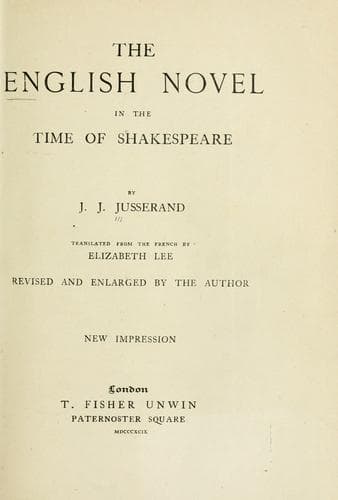
The English Novel in the Time of ShakespeareJusserand, J. J. (Jean Jules)
History
The English Novel in the Time of Shakespeare
Jusserand, J. J. (Jean Jules)
English fiction -- Early modern, 1500-1700 -- History and criticism
She is far too well bred and courtly, and she explains as follows what
she has felt: "My Lord, I assure you, that at such time as I sawe you
comming first into this court, my heart was then surprised, procured, as
I think by the destinies, that ever since I have vowed to rest yours."
This speech is made at a nightly garden meeting, similar to the one
where Romeo went "with love's light wings," and where was heard the
sweetest and gravest lovers' music that ever enchanted human ears:
"At lovers' perjuries,
They say Jove laughs. O gentle Romeo,
If thou dost love, pronounce it faithfully:
Or if thou think'st I am too quickly won,
I will frown and be perverse....
Well, do not swear: although I joy in thee,
I have no joy of this contract to-night.
It is too rash, too unadvised, too sudden;
Too like the lightning, which doth cease to be
Ere one can say, It lightens." ...
He of Bohemia had not come with "love's light wings," but "somewhat
before the hour, was gone forth in his night gowne, with his sworde
under his arme, and comming to the gate he was wont to goe in at into
the gardeine, found it shut, and having no other meanes, he gott over
the wall." We picture him clambering over the wall, his night-gown
flowing about him to do duty for love's wings. The lovers meet, and
"thus they spent the night in kinde salutations and curteous imbracings
to the unspeakable joy and comfort of them both."
To complete the external resemblance of the two situations, there is in
Ford's novel a young lord to play the part of "County Paris." He is
called Sicanus, and Laurana's family greatly favours his suit: "Laurana,
my cheefest care is to see thee married, according to thy state, which
hath made me send for thee, to know whether thou hast alreadie placed
thy affection or no: otherwise there is come into this country, a knight
of great estate," &c., &c. "Laurana departed with a heavie heart."
Then again, as in "Romeo," there is another meeting of the lovers, this
time in Laurana's chamber; and they spend the hours "in sweete
greetings, but farre from anie thought of unchastnesse, their imbracings
being grounded upon the most vertuous conditions that might bee: and
sitting together upon the beds side, Laurana told him...." As in Romeo,
they are parted by morn:
"Wilt thou be gone? it is not yet near day:
It was the nightingale, and not the lark....
--It was the lark, the herald of the morn,
No nightingale: look, love, what envious streaks
Do lace the severing clouds in yonder east....
--Yond light is not daylight...."
A very different morn shines in at Laurana's windows: "Nowe the dismall
houre of their parting being approached, by reason of the light that the
sunne began to give into the chamber, Parismus taking Laurana in his
armes, drawing sweete breath from her lippes, told her that now, to his
greefe, he must leave her to be courted by his enemie."
Public-domain text, read in full here on John Shaqi.
Reviews
Reviews
No reviews yet
Be the first to share your thoughts on this work.
Elsewhere in the archive
Join the Discussion
Join the discussion
Sign in to leave a comment or review.
Sign InorCreate an account