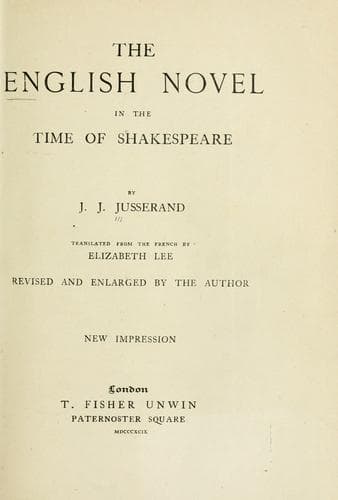
The English Novel in the Time of ShakespeareJusserand, J. J. (Jean Jules)
History
The English Novel in the Time of Shakespeare
Jusserand, J. J. (Jean Jules)
English fiction -- Early modern, 1500-1700 -- History and criticism
"Oh! mistres," answers the she-page, who cannot help feeling some spite,
"holde your peace, for you are partiall; who knowes not, but that all
women have desire to tie sovereigntie to their peticoats, and ascribe
beautie to themselves, where if boyes might put on their garments,
perhaps they would proove as comely; if not as comely, it may be more
curteous."
There are also some morning scenes full of pleasant mirth and cheerful
light, in which perhaps there is more of Phoebus than of the sun, and
more of Aurora than of the dawn; but this light, such as it is, is worth
the looking at, so merrily it shines; and the talk of these early risers
well suits the half-classic landscape.
"The sunne was no sooner stept from the bed of Aurora, but Aliena was
wakened by Ganimede, who restlesse all night, had tossed in her
passions; saying it was then time to goe to the field to unfold their
sheepe.
"Aliena ... replied thus: What? wanton, the sun is but new up, and as
yet Iris riches lies folded in the bosom of Flora; Phoebus hath not
dried the pearled deaw, and so long Coridon hath taught me it is not fit
to lead the sheepe abroad lest the deaw being unwholesome they get the
rot. But now see I the old proverbe true ..." (and here comes some
euphuism).
"Come on," answers Ganimede, who does not seem in a mood to appreciate
euphuism just then, "this sermon of yours is but a subtiltie to lie
still a bed, because either you think the morning colde, or els I being
gone, you would steale a nappe; this shifte carries no palme, and
therefore up and away. And for Love, let me alone; Ile whip him away
with nettles and set Disdaine as a charme to withstand his forces; and
therefore, looke you to your selfe; be not too bolde, for Venus can make
you bend; nor too coy, for Cupid hath a piercing dart that will make you
cry _Peccavi_.
"And that is it, quoth Aliena, that hath raysed you so early this
morning?
"And with that she slipt on her peticoate, and start up; and assoone as
she had made her readie and taken her breakfast, away goe these two with
their bagge and bottles to the field, in more pleasant content of mind
than ever they were in the court of Torismond."
In the same way as in Shakespeare, fair Phoebe, deceived by Rosalind's
dress, Phoebe, who thought herself beyond the reach of love, becomes
enamoured of the page and feels at last all the pangs of an unrequited
passion. Lodge's Rosalind, more human we think than her great
Shakespearean sister, uses, to persuade Phoebe into loving Montanus, a
kindly, tender language, meant to heal rather than irritate the poor
shepherdess's wounds. "What!" will exclaim the great sister, ...
Public-domain text, read in full here on John Shaqi.
Reviews
Reviews
No reviews yet
Be the first to share your thoughts on this work.
Elsewhere in the archive
Join the Discussion
Join the discussion
Sign in to leave a comment or review.
Sign InorCreate an account