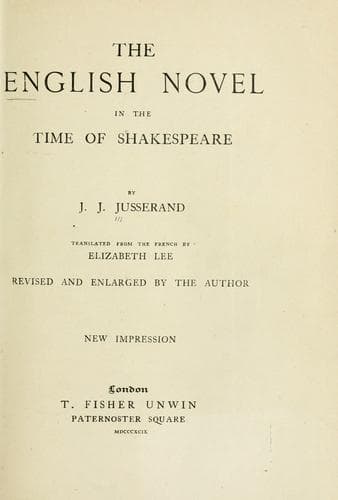
The English Novel in the Time of ShakespeareJusserand, J. J. (Jean Jules)
History
The English Novel in the Time of Shakespeare
Jusserand, J. J. (Jean Jules)
English fiction -- Early modern, 1500-1700 -- History and criticism
"... What though you have no beauty ...
Must you be therefore proud and pitiless?
Why, what means this? Why do you look on me?
I see no more in you than in the ordinary
Of nature's sale-work: Od's my little life!
I think she means to tangle my eyes too:--
No, 'faith, proud mistress, hope not after it;
'Tis not your inky brows, your black silk-hair,
Your bugle eyeballs, nor your cheek of cream
That can entame my spirits to your worship."[162]
Very spiritless, and tame, and old fashioned, will the other Rosalind
appear by the side of this impetuous, relentless deity. A few perhaps
will consider that her tame, kindly, old-fashioned, mythological piece
of advice to the shepherdess, makes her the more lovable: "What,
shepheardesse, so fayre and so cruell?... Because thou art beautifull,
be not so coye: as there is nothing more faire, so there is nothing more
fading, as momentary as the shadowes which growes from a cloudie sunne.
Such, my faire shepheardesse, as disdaine in youth, desire in age, and
then are they hated in the winter, that might have been loved in the
prime. A wrinkled maid is like a parched rose, that is cast up in
coffers to please the smell, not worn in the hand to content the eye.
There is no folly in love to had-I-wist, and therefore, be rulde by me.
Love while thou art young, least thou be disdained when thou art olde.
Beautie nor time cannot bee recalde, and if thou love, like of Montanus;
for if his desires are manie, so his deserts are great."[163] And it is
indeed quite touching to see poor Montanus in the simplest lover fashion
verify by his acts this description of himself; for while reduced to the
last degree of despair, seeing the unconquerable love Phoebe entertains
for the page, he beseeches Rosalind to save her by returning her love;
sorrow will kill him any way, but he will die contented if he thinks
that even through another's love Phoebe will live happy in her Arcadian
vale.
I need not add that all these troubles end as happily as possible; the
storms pass away and a many-coloured rainbow encompasses Arden, Arcady,
and the kingdom of France; every lover becomes loved, the three couples
get married, and while the music of the bridal fete is still in our
ears, news is brought that "hard by, at the edge of this forest, the
twelve peers of France are up in arms" to recover Gerismond's rights.
They accomplish this feat in a twinkling, as French peers should; why
they did not do it before does not appear: probably because the treble
marriage would not have looked so pretty in Notre Dame as under the
lemon trees. There is much bloodshed of course, but it is blood we do
not care for, and we are allowed to part from our shepherd friends with
the pleasing thought that they will see no end to their loves and
happiness.
Public-domain text, read in full here on John Shaqi.
Reviews
Reviews
No reviews yet
Be the first to share your thoughts on this work.
Elsewhere in the archive
Join the Discussion
Join the discussion
Sign in to leave a comment or review.
Sign InorCreate an account