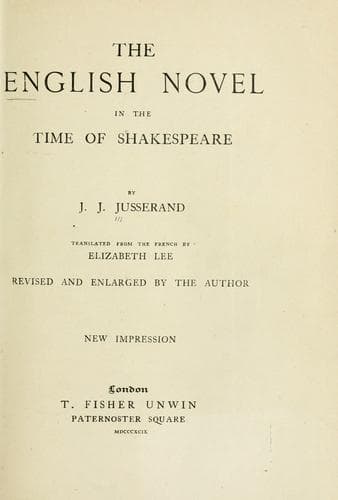
The English Novel in the Time of ShakespeareJusserand, J. J. (Jean Jules)
History
The English Novel in the Time of Shakespeare
Jusserand, J. J. (Jean Jules)
English fiction -- Early modern, 1500-1700 -- History and criticism
[164] "Saladin's meditation with himself: 'Saladin, art thou disquieted
in thy thoughts?'" &c. "Rosalind's passion: 'Unfortunate Rosalind, whose
misfortunes are more than thy years,'" &c. "Aliena's meditation: 'Ah!
me; now I see, and sorrowing sigh to see that Diana's laurels are
harbours for Venus doves,'" &c.
[165] For example, in "the schedule annexed to Euphues testament," by
which the dying man leaves the book to Philautus for the benefit of his
children. They will find in it what is fit for the God Love, "roses to
whip him when he is wanton, reasons to whistant him when he is wilie."
In the same manner Sir John of Bourdeaux informs his sons that "a
woman's eye as it is precious to behold, so is it prejudicial to gaze
upon"; Rosalind observes to herself that "the greatest seas have the
sorest stormes, the highest birth is subject to the most bale and of all
trees the cedars soonest shake with the wind," &c. The same style is
used in "Euphues shadow" in "Robin the divell," &c.: "Thou art like the
verven (Nature) poyson one wayes, and pleasure an other, feeding me with
grapes in shewe lyke to Darius vine, but not in substance lyke those of
Vermandois" ("Robin the divell").
[166] "A Looking glasse for London and England." This drama was written
by Lodge and by his friend Greene. The following stage direction occurs
in it: "Ionas the prophet cast out of the whales belly upon the stage."
[Illustration: PENSHURST, SIDNEY'S BIRTHPLACE.]
CHAPTER V.
SIR PHILIP SIDNEY AND PASTORAL ROMANCE.
Public-domain text, read in full here on John Shaqi.
Reviews
Reviews
No reviews yet
Be the first to share your thoughts on this work.
Elsewhere in the archive
Join the Discussion
Join the discussion
Sign in to leave a comment or review.
Sign InorCreate an account