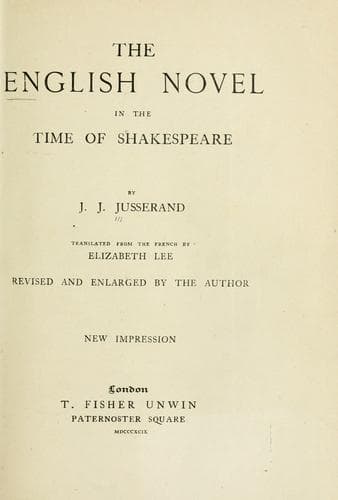
The English Novel in the Time of ShakespeareJusserand, J. J. (Jean Jules)
History
The English Novel in the Time of Shakespeare
Jusserand, J. J. (Jean Jules)
English fiction -- Early modern, 1500-1700 -- History and criticism
When nowadays we see our shepherds, wrapped in their long brown cloaks,
silently following the high roads in the midst of a suffocating dust
which seems to come out of their sheep, it is difficult to explain the
enthusiasm that has ascribed to this race of mutes such fine speeches
and such pleasant adventures. Greeks, Romans, Italians, Spaniards, the
French and the English, have differed in a multitude of points, but they
have one and all delighted in pastorals. No class of heroes either in
history or fiction has uttered so much verse and prose as the keepers of
sheep. Neither Ajax son of Telamon, nor the wise king of Ithaca, nor
Merlin, Lancelot, or Charlemagne, nor even the inexhaustible Grandison,
can bear the least comparison with Tityrus. It is easy to give many
reasons for this; but the phenomenon still remains somewhat strange. The
best explanation is perhaps that the pastoral is one of the most
convenient pretexts existing for saying what would otherwise be
embarrassing. To many authors the eclogue is like a canvas for trying
their colours and brushes. Many would not willingly confess it, and Pope
would have vowed a mortal hatred to any one who explained his eclogues
thus: but it is better for his reputation to believe that he had at
least that reason for writing them. For some, the pastoral is an
allegory, where, if one would, place can be given to Cynthia, Queen of
the Sea, that is to say, to Elizabeth, and to a Shepherd of the Ocean
who is Raleigh; it allows the poet to speak to kings, to ask alms
discreetly of them, and to thank them.
In England in Shakespeare's time people were passionately fond of the
country of Arcadia, not the Arcady "for better for worse" that can be
seen anywhere outside London,[167] but the old poetical Arcadia, the
Arcadia of nowhere, which was the more cherished on account of its
non-existence. They could invent at their ease, imagine prodigious
adventures and wonderful amours; since no one had ever been in Arcadia,
it was hardly possible for any one to protest that events happened
differently there. To-day we think in quite another way; we must be told
of well-ascertained facts, of warranted catastrophes, at once certified
and provable. That is why the action of our novels, far from carrying
us into Arcadia, often unfolds itself in our kitchens and on our back
staircases. It is not at all as it was in the time of Robert Greene.
Public-domain text, read in full here on John Shaqi.
Reviews
Reviews
No reviews yet
Be the first to share your thoughts on this work.
Elsewhere in the archive
Join the Discussion
Join the discussion
Sign in to leave a comment or review.
Sign InorCreate an account