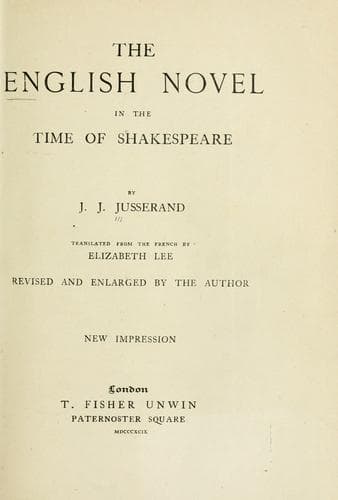
The English Novel in the Time of ShakespeareJusserand, J. J. (Jean Jules)
History
The English Novel in the Time of Shakespeare
Jusserand, J. J. (Jean Jules)
English fiction -- Early modern, 1500-1700 -- History and criticism
In 1575, when twenty-one years old, Sidney returned to shine at court,
where his uncle Leicester, the Queen's favourite was to make all things
easy for him. He assisted that year at the fetes given in Elizabeth's
honour at Kenilworth, in those famous gardens "though not so goodly,"
writes a witness of the festivities, "as Paradis, for want of the fayr
rivers, yet better a great deal by the lack of so unhappy a tree."[175]
Then Sidney accompanied the Queen to Chartley, and these ceremonies mark
a great epoch in his existence. While Elizabeth listened to the
compliments of her entertainers, Sidney's eyes were fixed on a child. A
sentiment, the full strength of which he was to feel only in after time,
sprang up in his heart for Penelope Devereux, the twelve-year-old
daughter of the Earl of Essex, who was as beautiful as Dante's Beatrice.
He began to visit at her father's house frequently; it seemed as if a
marriage would ensue; Essex himself was favourable to it, but for some
cause or other Sidney did not press his suit; and while his friend
Languet strongly advised him to marry, he was answering him in the
leisurely style of one who believes himself heart-whole: "Respecting her
of whom I readily acknowledge how unworthy I am, I have written you my
reasons long since, briefly indeed, but yet as well as I was able."[176]
He was soon to write in a very different manner. Penelope, the Stella of
Sidney's verse, was, very much against her will, compelled at last by
her family to marry the wealthy Lord Rich, and then Sidney awoke to his
fate: what he had believed to be mere inclination, a light feeling of
which he would always remain the master, had from the first been Love,
irrepressible, unconquerable love:
"I might;--unhappie word--O me, I might,
And then would not, or could not see my blisse;
Till now wrapt in a most infernall night,
I find how heav'nly day, wretch! I did miss."[177]
He remained a lover of Stella, saw her, wrote to her, sang of her, and
at length ascertained that she too, despite her marriage ties, loved
him. He continued then, in altered tones, the magnificent series of
sonnets dedicated to her and which read still like a love-drama of real
life, a love-drama which is all summarized in the beautiful and
well-known dirge:
"Ring out your belles, let mourning shewes be spread;
For Love is dead:
All Love is dead, infected
With plague of deep disdaine:
Worth, as nought worth, rejected
And Faith faire scorne doth game.
From so ungratefull fancie,
From such a femall franzie
From them that use men thus,
Good Lord, deliver us!
Weepe, neighbours, weepe; do you not heare it said
That Love is dead?
* * * * *
Public-domain text, read in full here on John Shaqi.
Reviews
Reviews
No reviews yet
Be the first to share your thoughts on this work.
Elsewhere in the archive
Join the Discussion
Join the discussion
Sign in to leave a comment or review.
Sign InorCreate an account