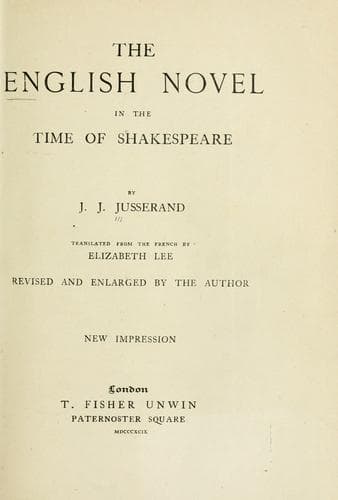
The English Novel in the Time of ShakespeareJusserand, J. J. (Jean Jules)
History
The English Novel in the Time of Shakespeare
Jusserand, J. J. (Jean Jules)
English fiction -- Early modern, 1500-1700 -- History and criticism
Alas! I lie: rage hath this errour bred;
Love is not dead;
Love is not dead, but sleepeth
In her unmatched mind,
Where she his counsell keepeth,
Till due desert she find.
Therefore from so vile fancie
To call such wit a franzie,
Who Love can temper thus,
Good Lord, deliver us!"
Love that was not dead but asleep awoke, and Sidney's raptures were
again expressed in his verse:
"O joy too high for my low stile to show!...
For Stella hath, with words where faith doth shine,
Of her high heart giv'n me the monarchie:
I, I, O I, may say that she is mine."[178]
This lasted some time and when love faded away, at least in Stella's
fickle heart, "Astrophel" wrote the real dirge of his passion.
Sidney had nevertheless continued his active life all this while,
sometimes at court and sometimes on the continent, recognized as a
statesman by statesmen, as a poet by poets, as a perfect knight by all
experts in knightly accomplishments. Spenser dedicated in 1579 his
"Shepheardes Calender" to "the most noble and vertuous gentleman, most
worthy of all titles, both of learning and chevalrie, M. Philip
Sidney"[179]; and William the Silent, Prince of Orange, once said to
Fulke Greville that "Her Majesty had one of the ripest and greatest
counsellors of estate in Sir Philip Sidney that at this day lived in
Europe." The remaining years of his short life were well filled; he had
been ambassador to the German Emperor in 1577; he had taken part at
home, though unasked, in the negotiations concerning the Queen's
marriage, and he lost favour for a while on account of the extraordinary
freedom with which he had written to Elizabeth against the French match.
He retired from court at that moment and went to live in the country;
while staying with his sister at Wilton in the midst of congenial
surroundings, he wrote most of his "Arcadia" (1580). He was a member of
Parliament in 1581 and 1584, and married in 1583 the daughter of Sir
Francis Walsingham. He all but accompanied Drake to America, where he
had received from the Queen a large grant of lands; he became at last
Governor of Flushing in the Netherlands. He died in that country at
thirty-one years of age, in 1586, of a wound received at Zutphen; a
premature death that gave the finishing touch to men's sympathy and love
for him; all England wept for him.[180] Even now, it is difficult to
think unmoved of his well-filled career ending on the eve of the great
triumphs of his country, to call to our memory this brave man who died
with his face to the enemy without knowing that victory would be
declared for his side, without having known Shakespeare, without having
seen the defeat of the Armada.
Public-domain text, read in full here on John Shaqi.
Reviews
Reviews
No reviews yet
Be the first to share your thoughts on this work.
Elsewhere in the archive
Join the Discussion
Join the discussion
Sign in to leave a comment or review.
Sign InorCreate an account