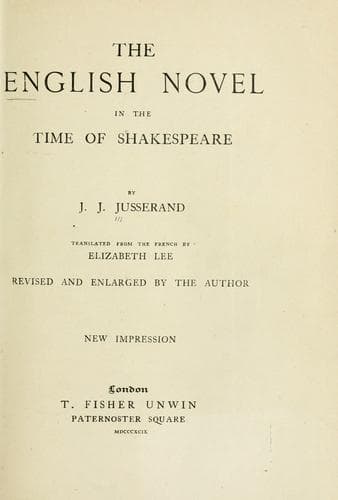
The English Novel in the Time of ShakespeareJusserand, J. J. (Jean Jules)
History
The English Novel in the Time of Shakespeare
Jusserand, J. J. (Jean Jules)
English fiction -- Early modern, 1500-1700 -- History and criticism
But, by the side of these graceful flowers, how many others are faded!
What concessions to contemporary taste for tinsel and excessive
ornament! Sidney forgets the rules of enduring beauty, and with the
excuse that he will never be printed, he only seeks to please his one
reader. To charm the Countess, his sister, like most women of his time,
it was necessary to put his phrases in full dress, to place ruffs on his
periods, and to make them walk according to the rules followed in
courtly pageants. When, in spite of Sidney's earnest desire, his book
was published after his death, people were enraptured with his
ingeniously dressed out phrases. Lyly might shake with envy without
having however the right to complain, for Sidney did not imitate him.
Sidney never liked euphuism, quite the contrary, he formally condemns it
in his "Apologie": "Now for similitudes in certain printed discourses I
think all herberists, all stories of beasts, fowles and fishes, are
rifled up, that they may come in multitudes to wait upon any of our
conceits, which certainely is as absurd a surfet to the eares as is
possible." But his own style is scarcely less artificial than that of
Lyly, and consequently, its rules are quite as easy to discover.
They consist firstly in the antithetical and cadenced repetition of the
same words in the sentences written merely for effect; secondly, in
persistently ascribing life and feeling to inanimate objects. Sidney, it
is true, as Lyly with his euphuism, happily only employs this style on
particular occasions, when he intends to be especially attractive and
brilliant. A few specimens will afford means of judging, and will show
how difficult it was in Shakespeare's time, even for the best educated
and most sensible men, for the sincerest admirers of the ancients, to
keep within the bounds of good taste and reason. They might appeal to
the Castalian virgins in their invocations, but William Rogers'
Elizabeth was the Muse that rose before their eyes.
Public-domain text, read in full here on John Shaqi.
Reviews
Reviews
No reviews yet
Be the first to share your thoughts on this work.
Elsewhere in the archive
Join the Discussion
Join the discussion
Sign in to leave a comment or review.
Sign InorCreate an account