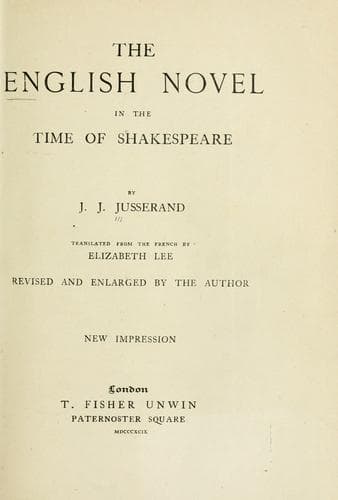
The English Novel in the Time of ShakespeareJusserand, J. J. (Jean Jules)
History
The English Novel in the Time of Shakespeare
Jusserand, J. J. (Jean Jules)
English fiction -- Early modern, 1500-1700 -- History and criticism
silly love for Pyrocles-Zelmane, and proclaims, unasked, Queen Gynecia
the most virtuous woman that ever was. The Queen blushes deeply and says
nothing, but finding that the ties of her passion are now broken, she
inwardly pledges herself to live in order to justify her husband's
praise. She becomes the "example and glory of Greece: so uncertain are
mortall judgements, the same person most infamous and most famous, and
neither justly."
This might be taken as a sufficient conclusion in so loose a tale; but
in that case it would mean giving up many heroes whose fates are yet in
suspense. In fact, an "Arcadia" of this sort might be continued till
doomsday. Unless the hand of the writer grew tired, there is no reason
why it should ever end. This is, in fact, the one and only reason Sidney
puts forth as an excuse for taking his leave; he makes no pretence of
having finished, just the reverse; for when he has married his princes
he concludes thus: "But ... the strange stories of Artaxia and
Plexirtus, Erona and Plangus, Hellen and Amphialus, with the wonderful!
chances that befell them; the shepheardish loves of Menalcas with
Kalodulus daughter; the poore hopes of the poor Philisides," that is,
Sidney himself, "in the pursuit of his affections; the strange
continuance of Klaius and Strephons desire; lastly the sonne of Pyrocles
named Pyrophilus, and Melidora the faire daughter of Pamela by
Musidorus, who even at their birth entred into admirable fortunes, may
awake some other spirit to exercise his pen in that wherwith mine is
already dulled." From generation to generation the tale might as we see,
have been continued for ages: so numerous were the wonderful adventures
still to be told.
The style of the book is scarcely less fanciful than the stories it
tells. It is only now and again that the charming prose of the "Apologie
for Poetrie" is to be found in the "Arcadia." Sidney wished to remain
faithful to his theories, and he believed it possible to write a poem in
prose.[208] Here and there some speeches, passionate like those of
Gynecia, or noble like Pamela's prayer, some brilliant repartee, a few
observations of exquisite charm are lasting beauties, always in their
place in all kinds of writing. Thus we meet the witty Sidney of the
"Apologie" in the description of a spaniel, coming out of a river, who
shakes off the water from his coat "as great men doe their friends;"
Sidney, the poet and lover, appears in the description of Philoclea
entering the water "with a prettie kind of shrugging ... like the
twinkling of the fairest among the fixed stars;" or in this expression
in reference to the fair hair of one of his heroines: "her haire--alas
too poore a word, why should I not rather call them her beams!"[209]
Public-domain text, read in full here on John Shaqi.
Reviews
Reviews
No reviews yet
Be the first to share your thoughts on this work.
Elsewhere in the archive
Join the Discussion
Join the discussion
Sign in to leave a comment or review.
Sign InorCreate an account