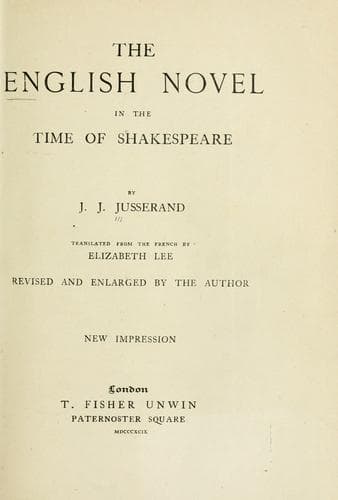
The English Novel in the Time of ShakespeareJusserand, J. J. (Jean Jules)
History
The English Novel in the Time of Shakespeare
Jusserand, J. J. (Jean Jules)
English fiction -- Early modern, 1500-1700 -- History and criticism
[182] Sidney left only one daughter who became Countess of Rutland. His
wife remarried twice, first with the Earl of Essex, brother of Penelope,
then with Lord Clanricarde.
[183] "Essayes," London, 1603, fol. Dedication of Book II. This
"Epistle" is followed by two sonnets, one to each lady, again praising
them for their connection with Sidney. The sonnet to Penelope begins
thus:
"Madame, to write of you, and doe you right,
What meane we, or what meanes to ayde meane might?
Since HE who admirably did endite,
Entiteling you perfections heire, joies light,
Loves life, lifes gemme, vertues court, Heav'ns delight,
Natures chiefe worke, fair'st booke, his muses spright,
Heav'n on earth, peerlesse Phoenix, Phoebe bright,
Yet said he was to seeke, of you to write" (p. 191).
This last line alludes to Astrophel's first sonnet to Stella (quoted
below, p. 233).
[184] "What changes here," &c. "translated out of the 'Diana' of
Montemayor in Spanish. Where Sireno a shepheard pulling out a little of
his mistresse Diana's haire, wrapt about in greene silke, who now had
utterly forsaken him, to the haire hee thus bewayled himselfe."--"The
same Sireon ... holding his mistresse glasse ... thus sung." "Certaine
sonnets written by Sir Philip Sidney, never before printed."
[185] This masque was written in 1578; and was performed before the
Queen when staying with the Earl of Leicester at Wanstead. Sidney wrote
also for festivities of the same kind a "Dialogue betweene two
shepheards, uttered in a pastorall shew at Wilton" (the seat of his
sister the Countess of Pembroke). Both works are to be found in divers
old editions of the "Arcadia" (_e.g._, the eighth, 1633, fol.), which in
fact contain, very nearly, Sidney's complete works.
[186] The "Apologie" written about 1581, which circulated in MS. during
Sidney's life-time, was published only after his death: "An Apologie for
Poetrie, written by the right noble, vertuous and learned Sir Philip
Sidney, Knight," London, 1595, reprinted by Arber, London, 1869.
[187] Arber's reprint, pp. 46, 55, 41, and 40.
[188] "The Complete Poems of Sir Philip Sidney," ed. Grosart, London,
1877, 3 vol. 8vo; "Sir Philip Sidney's Astrophel and Stella ... edited
from the folio of 1598," by Alfred Pollard, London, 1888, 8vo.
[189] The "Arcadia" begun in 1580, appeared after Sidney's death: "The
Countesse of Pembrokes Arcadia, written by Sir Philippe Sidnei," London,
1590, 4to. Several of the numerous poems inserted in the "Arcadia" are
written in classical metres; for Sidney took part with several of his
contemporaries in the futile effort made in England as in France to
apply to modern languages the rules of ancient prosody. The pages
referred to in the following notes are those of the edition of 1633,
"now the eighth time published with some new additions."
Public-domain text, read in full here on John Shaqi.
Reviews
Reviews
No reviews yet
Be the first to share your thoughts on this work.
Elsewhere in the archive
Join the Discussion
Join the discussion
Sign in to leave a comment or review.
Sign InorCreate an account