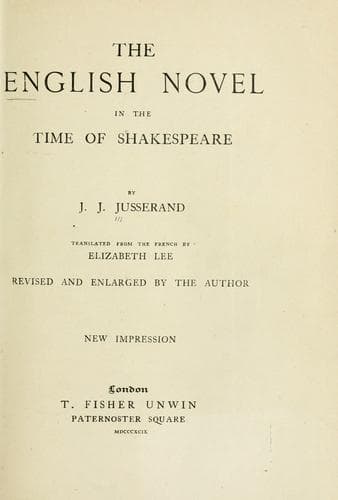
The English Novel in the Time of ShakespeareJusserand, J. J. (Jean Jules)
History
The English Novel in the Time of Shakespeare
Jusserand, J. J. (Jean Jules)
English fiction -- Early modern, 1500-1700 -- History and criticism
[190] And compared as such to Octavia, sister of Augustus, by Meres in
his "Paladis Tamia," 1598. She helped her brother in translating the
Psalms of David and published various works, one of them being a
translation of one of Garnier's neo-classical tragedies: "The tragedie
of Antonie," written in 1590, printed in 1595, which contains,
conformably to Sidney's taste, messengers, monologues and choruses. It
begins thus in the regular classical style of that time:
"Since cruel Heav'ns against me obstinate,
Since all mishappes of the round engin doo
Conspire my harme: since men, since powers divine,
Aire, earth, and sea are all injurious:
And that my queene her selfe, in whom I liv'd
The idoll of my harte, doth me pursue,
It's meete I dye."
[191] The "Diana" was turned into English by B. Yong, London, 1598, fol.
Shakespeare derived from one of the stories in Montemayor's romance (the
story of the shepherdess Felismena) a part of the plot of his "Two
Gentlemen of Verona." See above p. 150.
[192] Now in the Louvre.
[193] The taste for these fancies had been handed down from the Middle
Ages; ladies following as pages their own lovers, unknown to them,
abound in the French mediaeval literature; one, _e.g._, is to be found in
the "Tres chevaleureux Comte d'Artois," a very old tale, of which we
have only a version of the fifteenth century, but which existed long
before, and supplied Boccaccio with the groundwork of his story of
Giletta of Narbonne. From Boccaccio, this tale was transferred by
Paynter to his "Palace of Pleasure," and from this work, by Shakespeare,
to the stage, under the name of "All's well." Sidney's model Montemayor
gives the same part to play, as we have seen, to his pretended
shepherdess Felismena, who follows as his page her lover Don Felix.
[194] See "Les projets de mariage de Jacques V.," by Edmond Bapst,
Secretaire d'Ambassade, Paris, 1889, 8vo, ch. xxiv. p. 289.
[195] "Memoires of Sir James Melvil," London, 1683, fol., p. 51.
[196] Sonnet 41. See also Sonnet 53.
[197] "Captain Cox his ballads ... or Robert Laneham's Letter, 1575,"
ed. Furnivall, London, 1871, 8vo, p. 49.
[198] Book i. p. 8 (edition of 1633).
[199] Book ii. p. 99.
[200] Book iii. p. 382.
[201] "Life of Sidney," London, 1652, 12mo, p. 18.
[202] Book ii. p. 117.
[203] "Zelmane would have put to her helping hand, but she was taken
with such a quivering, that she thought it was more wisdome to lean her
selfe to a tree and look on" (book ii. p. 138).
[204] Book i. p. 65.
[205] Book ii. p. 95. The daughter's speeches though she believes
Zelmane to be a woman and cannot understand her own feelings are
scarcely less intemperate (book ii. p. 112).
[206] And in order that no doubt may exist, Milton refers his reader to
the page in Sidney and in Dr. Juxon's book of "[Greek: Eikonoklastes],"
"Prose Works," London, 1806, 6 vols., 8vo, vol. ii. p. 407.
Public-domain text, read in full here on John Shaqi.
Reviews
Reviews
No reviews yet
Be the first to share your thoughts on this work.
Elsewhere in the archive
Join the Discussion
Join the discussion
Sign in to leave a comment or review.
Sign InorCreate an account