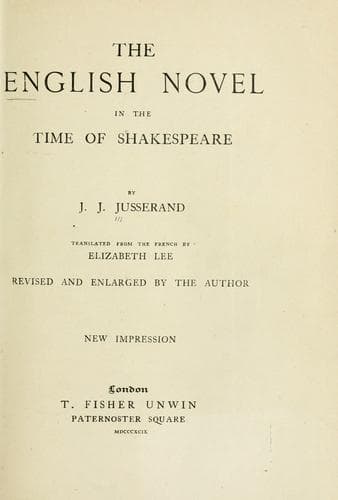
The English Novel in the Time of ShakespeareJusserand, J. J. (Jean Jules)
History
The English Novel in the Time of Shakespeare
Jusserand, J. J. (Jean Jules)
English fiction -- Early modern, 1500-1700 -- History and criticism
[207] "Arcadia," book iii. p. 248. In the "[Greek: Eikon Basilike], the
portraiture of his sacred majesty in his solitude and sufferings," 1648,
8vo, towards the end of the book, where are to be found "praiers used by
his majestie in the time of his sufferings, delivered to Dr. Juxon,
bishop of London, immediately before his death," the end of the prayer
of course is altered: "... so that at the last, I may com to thy eternal
kingdom through the merits of thy son our alone Saviour Jesus Christ.
Amen."
[208] His contemporaries agreed in his belief: "Sir Philip Sidney writ
his immortal poem 'The Countesse of Pembrokes Arcadia' in prose; and yet
our rarest poet" (F. Meres "Paladis Tamia," 1598).
[209] Pp. 138 and 51.
[210] On this and other occasions Sidney combines alliteration with the
repetition of words. Here is another example: "Is it to be imagined that
Gynecia, a woman, though wicked, yet witty, would have attempted and
atchieved an enterprise no lesse hazzardous than horrible without having
some counsellor in the beginning and some comforter in the performing?"
(book v. p. 466).
[211] Pp. 10, 17, 129, 267, &c. The same curious repetition of words is
sometimes to be noticed in Sidney's poetry:
"Nor faile my faith in my fayling fate;
Nor change in change, though change change my state."
("The Smokes of melancholie.")
[212] Pp. 2, 137, 51.
[213] "La, possible au sortir du combat, un oeillet tout sanglant tombe
de lassitude; la un bouton de rose, eufle du mauvais succes de son
antagoniste, s'epanouit de joie; la le lys, ce colosse entre les fleurs,
ce geant de lait caille, glorieux de voir ses images triompher au
Louvre, s'eleve sur ses compagnes et les regarde de haut en bas." Ice is
for Cyrano: "une lumiere endurcie, un jour petrifie, un solide neant"
("Lettre pour le printemps"; "Lettre a M. le Bret").
[214] Book i. p. 4.
[215] Here is an example among many others. Sidney's portrait, now
belonging to Earl Darnley, bears the following inscription painted on
its canvas: "S^r Phillip Sidney, who writ the Arcadia" (Tudor
Exhibition, 1890).
[216] "The Guls Horne-booke," "Works," ed. Grosart, vol. ii. p. 254.
[217] Act ii. sc. 1, performed 1599, printed 1600. See also in
"Bartholomew fair," performed in 1614, act iv. sc. 2, how Quarlous
chooses the word "Argalus" to try his luck in a love affair.
[218] The British Museum, which does not possess a complete collection,
has editions of 1590, 1598, 1599, 1605, 1613, 1621, 1623, 1627, 1629,
1633, 1638, 1655, 1662, 1674.
[219] From book ii. of the "Arcadia." It resembles the episode of
Gloucester and his sons, and shows the old King of Paphlagonia
dispossessed, become blind and led by his son Leonatus. See
"Shakespeare's Library," ed. Collier and Hazlitt, London, 1875, 6 vol.
8vo, "King Lear."
[220] A philosophical and scientific poem by N. Baxter, dedicated to the
Countess of Pembroke, Lady Mary Wroth, &c., and published in 1606, 4to.
Public-domain text, read in full here on John Shaqi.
Reviews
Reviews
No reviews yet
Be the first to share your thoughts on this work.
Elsewhere in the archive
Join the Discussion
Join the discussion
Sign in to leave a comment or review.
Sign InorCreate an account