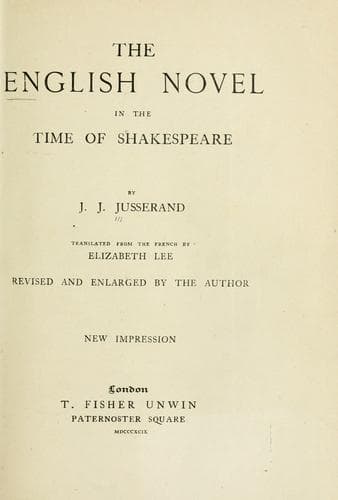
The English Novel in the Time of ShakespeareJusserand, J. J. (Jean Jules)
History
The English Novel in the Time of Shakespeare
Jusserand, J. J. (Jean Jules)
English fiction -- Early modern, 1500-1700 -- History and criticism
Minute research has been made, in every country, into the origin of the
drama. The origin of the novel has rarely tempted the literary
archaeologist. For a long time the novel was regarded as literature of a
lower order; down almost to our time, critics scrupled to speak of it.
When M. Villemain in his course of lectures on the eighteenth century
came to Richardson, he experienced some embarrassment, and it was not
without oratorical qualifications and certain bashful doubts that he
dared to announce lectures on "Clarissa Harlowe" and "Sir Charles
Grandison." He sought to justify himself on the ground that it was
necessary to track out a special influence derived from England, "the
influence of imagination united to moral sentiment in eloquent prose."
But this neglect can be explained still better. We can at need fix the
exact period of the origin of the drama. It is not the same with the
novel. We may go as far back as we please, yet we find the thin
ramifications of the novel, and we may say literally that it is as old
as the world itself. Like man himself, was not the world rocked in the
cradle of its childhood to the accompaniment of stories and tales? Some
were boldly marvellous; others have been called historical; but very
often, in spite of the dignity of the name, the "histories" were nothing
but collections of traditions, of legends, of fictions: a kind of novel.
This noble antiquity might doubtless have been invoked as a further
justification by M. Villemain and have confirmed the reasons drawn from
the "moral sentiment and eloquence" of novels, reasons which were such
as to rather curtail the scope of his lectures.
In England as much and even more than with any other modern nation,
novelists can pride themselves upon a long line of ancestors. They can,
without abusing the license permitted to genealogists, go back to the
time when the English did not inhabit England, when London, like Paris,
was peopled by latinised Celts, and when the ancestors of the puritans
sacrificed to the god Thor. The novelists indeed can show that the
beginning of their history is lost in the abysm of time. They can recall
the fact that the Anglo-Saxons, when they came to dwell in the island of
Britain, brought with them songs and legends, whence was evolved the
strange poem of "Beowulf,"[4] the first epic, the most ancient history,
and the oldest English romance. In it, truth is mingled with fiction;
besides the wonders performed by the hero, a destroyer of monsters, we
find a great battle mentioned by Gregory of Tours, where the Frenchmen,
that were to be, cut to pieces the Englishmen that were to be; the first
act of that bloody tragedy continued afterwards at Hastings, Crecy,
Agincourt, Fontenoy, and Waterloo.
Public-domain text, read in full here on John Shaqi.
Reviews
Reviews
No reviews yet
Be the first to share your thoughts on this work.
Join the Discussion
Join the discussion
Sign in to leave a comment or review.
Sign InorCreate an account