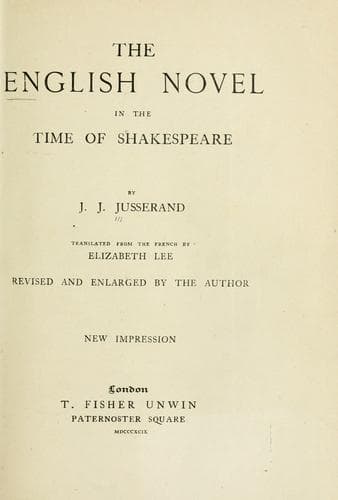
The English Novel in the Time of ShakespeareJusserand, J. J. (Jean Jules)
History
The English Novel in the Time of Shakespeare
Jusserand, J. J. (Jean Jules)
English fiction -- Early modern, 1500-1700 -- History and criticism
This study was undertaken by several of his contemporaries. One of the
peculiarities of this first awakening of the novel in England, is that
it was nearly complete and produced, if not standard masterpieces, at
least curious examples of nearly all the different kinds of novel with
which later writers have made us familiar. We have seen already how Lyly
depicted courtly life, and tried to use the novel as a vehicle for wise
and philosophical advice; how Greene, Lodge and Sidney busied themselves
with romantic tales; how Greene tried to describe the realities of life
in some of his autobiographical stories. There was something more to do
in this line, and the Elizabethan drama offers innumerable examples of
it; but it is not so well known that in the time of Shakespeare, there
were in circulation, besides romantic and chivalrous tales, regular
realistic novels, the main object of which was to paint to the life
ordinary men and characters. These are the least known, but not the
least remarkable of the attempts made by Shakespeare's contemporaries in
the direction of the novel as we understand it.
Works of this kind took for the most part the shape to which has been
applied the name of _picaresque_. This was, like the pastoral, imported
into England from abroad: in the sixteenth century it shone with
particular brilliance in Spain. The incessant wars of that vast empire
on whose frontiers the sun never set, had favoured the multiplication of
adventurers, to-day great lords, to-morrow beggars; one day dangerous,
another day contemptible or ridiculous. "Such people there are living
and flourishing in the world, Faithless, Hopeless, Charityless: let us
have at them, dear friends, with might and main. Some there are, and
very successful too, mere quacks and fools: and it was to combat and
expose such as those, no doubt that _Laughter_ was made." So wrote in
our time William Thackeray,[249] who seems to have considered that the
age of the _picaro_ had not yet passed away, and that the novelist might
still with advantage turn his attention to him. However that may be the
great time for the rascal, the rogue, the knave, for all those persons
of no particular class whom adventures had left poor and by no means
peaceable, for the _picaro_ in all his varieties, was the sixteenth
century. A whole literature was devoted to describing the fortunes of
these strange persons; Spain gave it its name of _picaresque_ and
spread it abroad but did not altogether invent it. The rogue, who plays
tricks which deserve a hanging, had already filled and enlivened tales
in several languages. Master Reynard, in that romance of the Middle Ages
of which he is the hero, is something like a _picaro_. Another of them
is Til Eulenspiegel, whose adventures related in German furnished, in
1515, the subject of a very popular book;[250] even Panurge could at
need be placed in this great family. Only, with Master Reynard we live
Public-domain text, read in full here on John Shaqi.
Reviews
Reviews
No reviews yet
Be the first to share your thoughts on this work.
Elsewhere in the archive
Join the Discussion
Join the discussion
Sign in to leave a comment or review.
Sign InorCreate an account