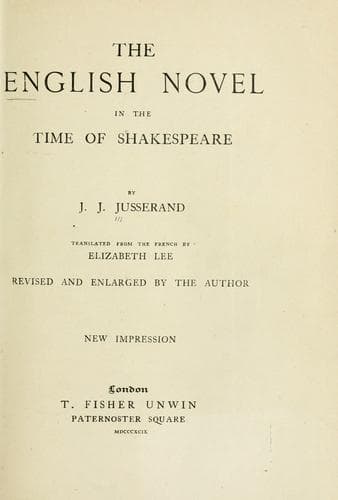
The English Novel in the Time of ShakespeareJusserand, J. J. (Jean Jules)
History
The English Novel in the Time of Shakespeare
Jusserand, J. J. (Jean Jules)
English fiction -- Early modern, 1500-1700 -- History and criticism
in the world of animals and the romance is allegorical; with Til
Eulenspiegel we find no truth, no probability, merely tricks for tricks'
sake, and how coarse they are! With Panurge, we are distracted from the
_picaro_ by all the philosophic and fantastic digressions of an
extensive tale in which he is not the principal hero. But with the
Spaniards, with Lazarillo de Tormes, Guzman d'Alfarache[251] and the
rest, the _picaro_ holds a place in literature which is peculiarly his
own. Faithless, shameless, if not joyless, the plaything of fortune, by
turn valet, gentleman, beggar, courtier, thief, we follow him into all
societies. From hovel to palace he goes first, opens the doors and shows
us the characters. There is no plot more simple or flexible, none that
lends itself better to the study of manners, of abuses, of social
eccentricities. The only defect is that, in order to abandon himself
with necessary good will to the caprices of Fate, and in order to be
able to penetrate everywhere, the hero has necessarily little conscience
and still less heart; hence the barrenness of the greater part of the
picaresque romances and the weak _role_, entirely incidental, reserved
in these works for sentiment.
The success of these Spanish romances was immediate and lasting
throughout Europe. "Lazarillo" and "Guzman" were translated into several
languages, and were greatly appreciated here and abroad. "What! sir,"
says the Burgundian lord in "Francion,"[252] "is it thus that you
cruelly deprive me of the narration of your more amusing adventures? Do
you not know that these commonplace actions are infinitely entertaining,
and that we take delight in listening even to those of scoundrels and
rascals like Guzman d'Alfarache and Lazarillo de Tormes?" "Guzman" had
in France several illustrious translators; the ponderous author of "La
Pucelle" and famous academician, Chapelain, was one of them; another was
Le Sage who, before penning this translation, had revived and doubled
the popularity of the picaresque novel in publishing his "Gil
Blas."[253] In Germany, Grimmelshausen, following the same models, wrote
in the seventeenth century his "Simplicissimus." In England "Guzman" was
several times translated; "Lazarillo" was continually reprinted during
two centuries, and original romances of this kind were published here,
among others, by Thomas Nash, in the sixteenth, by Richard Head in the
seventeenth, by Defoe and Smollett, in the eighteenth century. The
initiative of Nash and his group was all the more important and
meritorious because before them the comic element was greatly wanting in
the English prose romance; amusing stories in the manner of the French
had found translators sometimes, but not imitators; the authors of
Arcadias were especially concerned in depicting noble sentiments, and
the gift of observation possessed by the English people ran the risk of
being for a long time exercised nowhere but on the stage, or in metrical
tales, or in moral essays.
Public-domain text, read in full here on John Shaqi.
Reviews
Reviews
No reviews yet
Be the first to share your thoughts on this work.
Elsewhere in the archive
Join the Discussion
Join the discussion
Sign in to leave a comment or review.
Sign InorCreate an account