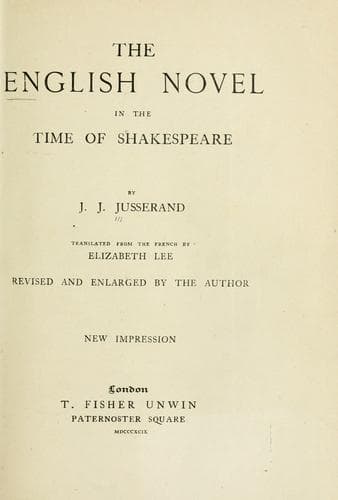
The English Novel in the Time of ShakespeareJusserand, J. J. (Jean Jules)
History
The English Novel in the Time of Shakespeare
Jusserand, J. J. (Jean Jules)
English fiction -- Early modern, 1500-1700 -- History and criticism
With this turn of mind and an inexhaustible fund of wit, satire, and
gaiety, he published numerous pamphlets, threw himself impetuously into
the Martin Marprelate controversy (in which another novelist, Lyly, was
also taking part); sustained a rude warfare against Gabriel Harvey;[259]
wrote a dissertation on social manners: the "Anatomie of absurditie,"
1589; a disquisition with an autobiographical turn, which may be
compared with those Greene has left; "Pierce Penilesse his supplication
to the Divell," 1592 (it had great success, and was even translated into
French, "maimedly translated," says Nash,[260] probably with great
truth); a novel "The unfortunate traveller or the life of Jack Wilton,"
1594, which has most undeservedly remained until now the least known of
his works; a drama, "The Isle of dogs," 1597, which is lost, and for
which the author was sent to prison; a curious and amusing discourse "in
praise of the red herring," 1599; and many other books, pamphlets, and
works of all kinds.[261]
Constantly entangled in quarrels, in such a way sometimes that the
authorities had to interfere--for example, in his war with Gabriel
Harvey, when the destruction of the books of both was ordered--he
preserved to the last his good humour and his taste for people and
authors who knew what it was to laugh. Curiously enough, he combined
this taste with an intense fondness for pure literature and for lyrical
poetry. Rabelais is among his masters, and so is Aretino, "one of the
wittiest knaves that ever God made." Tarleton the jester is among his
friends, and so is Kemp, the Dogberry of Shakespeare's "Much Ado," the
Peter of "Romeo and Juliet," the famous dancer who performed a morris
dance from London to Norwich. And at the same time he bestows with
unbounded enthusiasm heartfelt praises upon Spenser, "heavenly
Spenser"; upon "immortal" Sidney, whose "Astrophel and Stella" he
himself published in 1591; and upon Marlowe, as the author of the
exquisite Hero and Leander poem, "Leander and Hero of whome divine
Musaeus sung and a diviner muse then him, Kit Marlow."[262]
Public-domain text, read in full here on John Shaqi.
Reviews
Reviews
No reviews yet
Be the first to share your thoughts on this work.
Elsewhere in the archive
Join the Discussion
Join the discussion
Sign in to leave a comment or review.
Sign InorCreate an account