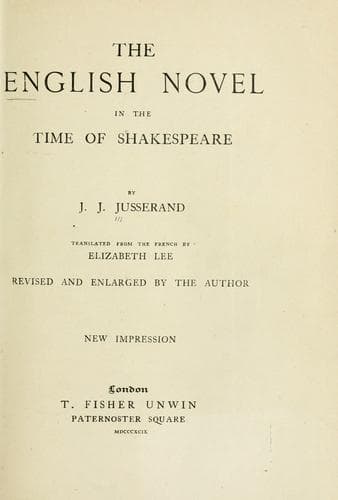
The English Novel in the Time of ShakespeareJusserand, J. J. (Jean Jules)
History
The English Novel in the Time of Shakespeare
Jusserand, J. J. (Jean Jules)
English fiction -- Early modern, 1500-1700 -- History and criticism
With all his fondness for merry authors, Nash can discern true poetry,
and he adores it. If by chance, in the midst of an angry satirical
disquisition, the word poetry comes to his pen, he is suddenly
transformed, he smiles, he melts; nothing is left in him but human
sympathies. "Nor is poetry an art where of there is no use in a man's
whole life but to describe discontented thoughts and youthfull desires,
for there is no study but it dooth illustrate and beautifie.... To them
that demaund what fruites the poets of our time bring forth, or wherein
they are able to approve themselves necessarie to the state, thus I
answere: first and formost, they have cleansed our language from
barbarisme, and made the vulgar sort, here in London, which is the
fountaine whose rivers flowe round about England, to aspire to a richer
puritie of speach than is communicated with the comminalty of any nation
under heaven."[263] When a man like Nash could write in such a strain,
with a passion for vernacular literature scarcely equalled at any time,
there was obviously growing among that "vulgar sort, here in London," a
public for any great man that might appear, a public for William
Shakespeare himself, who was just then beginning to reach celebrity.
Nash does not doubt that it is possible for English to become a
classical language, however rude the garb it first bore. According to
Nash, Surrey was "a prince in content because a poet without peere.
Destinie never defames her selfe but when she lets an excellent poet
die: if there bee any sparke of Adams paradized perfection yet emberd vp
in the breasts of mortall men, certainely God hath bestowed that his
perfectest image on poets." Differing from Francis Bacon and a few of
the grave dignitaries of literature, he has faith in that group of
artists in the first rank of whom he placed heavenly Spenser, who can
well bear comparison with any author of France, Italy, or Spain.
"Neither is he the only swallow of our summer."[264]
This fondness for pure literature, for musical verse and lyrical poetry,
explains how, satirist as he was, Nash had numerous friends whose
feelings towards him were nothing short of tenderness. "Sweet boy,"
"Sweet Tom," are not usual expressions towards a satirist; they are,
however, applied to Nash both by Greene and by Francis Meres, because
there was in Nash's mind something besides the customary rancour of born
satirists, "The man," said Shakespeare,
"The man that has no music in himself
Nor is not mov'd with concord of sweet sounds,
Is fit for treasons, stratagems and spoils;
The motions of his spirit are as dull as night,
And his affections dark as Erebus;
Let no such man be trusted."[265]
Public-domain text, read in full here on John Shaqi.
Reviews
Reviews
No reviews yet
Be the first to share your thoughts on this work.
Elsewhere in the archive
Join the Discussion
Join the discussion
Sign in to leave a comment or review.
Sign InorCreate an account