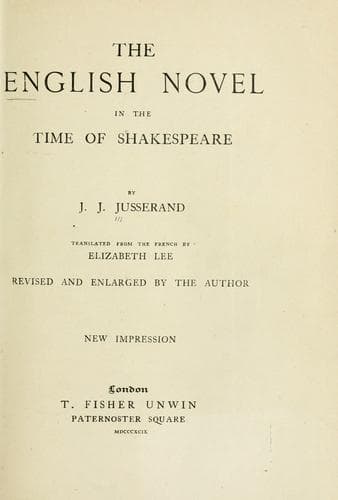
The English Novel in the Time of ShakespeareJusserand, J. J. (Jean Jules)
History
The English Novel in the Time of Shakespeare
Jusserand, J. J. (Jean Jules)
English fiction -- Early modern, 1500-1700 -- History and criticism
"Do I talke of any counterfeit birds, or hearbes or stones?... This I
will proudly boast ... that the vaine which I have ... is of my own
begetting and cals no man father in England but myselfe, neither
Euphues, nor Tarlton, nor Greene.
"Not Tarlton nor Greene but have beene contented to let my simple
judgment overrule them in some matters of wit. Euphues I read when I was
a little ape in Cambridge, and I then thought it was _ipse ille_: it may
be excellent still for ought I know, but I lookt not on it this ten
yeare: but to imitate it I abhorre."[268]
His vocabulary is very rich; he has always a variety of words at his
disposal and uses often two or three the better to impress our minds
with the idea in his own. He coins at need new words or fetches them
from classical or foreign languages. He does not do this in an off-hand
way, but on purpose and wilfully; he possessed much of that curious care
for and delight in words which is one of the characteristics of the men
of the Renaissance. To deal with words was in itself a pleasure for
them; they liked to mould, to adopt, to combine, to invent them. Word
painting delighted them; Nash has an extreme fondness for it, and
satirical and comical as he is, he often astonishes us by the poetic
gracefulness of his combinations of words. In this as in many other
particulars he imitates, _longe sequens_, the master he seems to have
admired above others, Rabelais, who, in the tempestuous roll of his
diverse waters, sometimes washes up on to the sand pearls fit to adorn
the crown of any lyrical poet. Fishes appear in Nash's otherwise
unpoetical prose as "the sea's finny freeholders;" the inhabitants of a
port town do not sow corn, "their whole harvest is by sea;" they plough
"the glassy fieldes of Thetis." He has an instinctive hatred for
abstract terms; he wants expressive words, words that shine, that
breathe, that live. Instead of saying that Henry III. _granted_ a
charter and certain privileges in a particular year of his _reign_, he
will write that "he _cheard up their blouds_ with two charters more, and
in Anno 1262 and forty-five of his _courte keeping_, he permitted them
to wall in their towne."[269] The pleasure of replacing stale,
commonplace expressions by rare, picturesque, live ones, and in lieu of
a plain sentence to give an allegorical substitute, has so much
attraction for Nash, that clear-sighted as he is, he cannot always avoid
the ordinary defects of this particular style, defects which he has in
common with many of his contemporaries, not excluding Shakespeare
himself, namely, obscurity and sometimes bad taste.
Public-domain text, read in full here on John Shaqi.
Reviews
Reviews
No reviews yet
Be the first to share your thoughts on this work.
Elsewhere in the archive
Join the Discussion
Join the discussion
Sign in to leave a comment or review.
Sign InorCreate an account