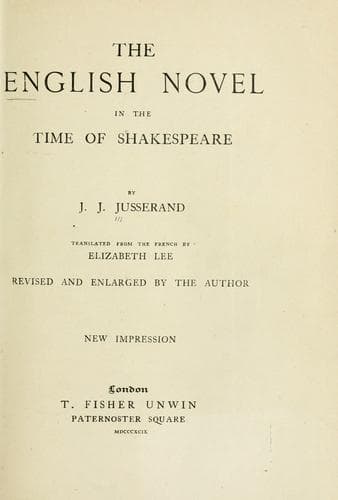
The English Novel in the Time of ShakespeareJusserand, J. J. (Jean Jules)
History
The English Novel in the Time of Shakespeare
Jusserand, J. J. (Jean Jules)
English fiction -- Early modern, 1500-1700 -- History and criticism
Another of Nash's tendencies, which he has most decidedly in common with
Rabelais, consists in the use of a number of expressions in the same
sentence for the same idea. Of course one carefully chosen word would
be enough; such a man as Merimee, to take an example at the other
extremity of the line, picks out the one term he wants, puts it in its
place; word and place fit exactly; there is nothing to add or desire.
Not so Rabelais; not so either his admirer Nash; the newly-awakened
curiosities of the Renaissance were too young as yet, too fresh and
strong upon them, to be easily kept down by rule and reflection.
Literature too was young then, and young things are endowed with eyes
that stare and admire more easily than old ones. When entering their
word-shop, writers of the sixteenth century were fain to take this word,
and this other too, and yet that one more; and when on the threshold,
about to go, they would turn and take two or three again. There are
pages in Rabelais and pages in Nash where most of the important words
are supplemented and fortified with a number of others placed there at
our disposal as alternatives or substitutes, for the pleasure of our
ears and eyes, in case we might like them better. Nash has to express
this very simple idea: Look at Yarmouth, what a fine town it is! Well,
it owes all it is to the red herring. This he formulates in the
following manner with quite a Rabelaisian mixture of native and half
Latin words and iterations for most terms of importance: "Doe but
convert, said hee, the slenderest twinckling reflexe of your eye-sight
to this flinty ringe that engirtes it, these towred walles, port-cullizd
gates, and gorgeous architectures that condecorate and adorne it, and
then perponder of the red herringes priority and prevalence, who is the
onely inexhaustible mine that hath raised and begot all this, and,
minutely, to riper maturity, fosters and cherisheth it."[270]
Public-domain text, read in full here on John Shaqi.
Reviews
Reviews
No reviews yet
Be the first to share your thoughts on this work.
Elsewhere in the archive
Join the Discussion
Join the discussion
Sign in to leave a comment or review.
Sign InorCreate an account