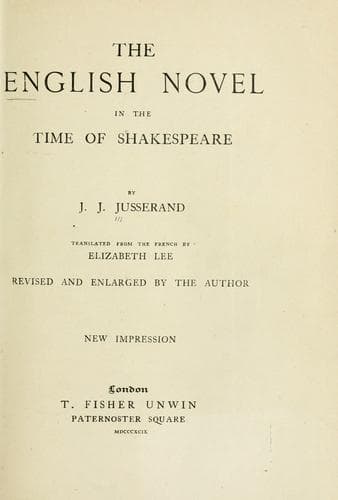
The English Novel in the Time of ShakespeareJusserand, J. J. (Jean Jules)
History
The English Novel in the Time of Shakespeare
Jusserand, J. J. (Jean Jules)
English fiction -- Early modern, 1500-1700 -- History and criticism
His ideas regarding the art of novel writing are very liberal, and he
accepts as belonging to literature many specimens we should sternly
reject. The one point to remember, however, is that he does not accept
them all; he draws the line somewhere, and in that age when the novel
was in its infancy, there was merit in doing even no more than this. He
is very hard upon the old mediaeval romances, which it is true he seems
to have known only through the abridged and degenerate texts circulated
in his time, for the amusement of idle readers. He readily endorses the
moral views of Ascham about them, adding however, what is more
interesting for us, some literary criticism: "What els I pray you, doe
these bable booke-mungers endevor but to repaire the ruinous wals of
Venus court, to restore to the worlde that forgotten legendary licence
of lying, to imitate a fresh the fantasticall dreames of those exiled
Abbie-lubbers [_i.e._, the monks] from whose idle pens proceeded those
worne out impressions of the feigned no where acts of Arthur of the
rounde table, Arthur of litle Brittaine, Sir Tristram, Hewon of
Burdeaux, the Squire of low degree, the four sons of Amon, with
infinite others.... Who is it that reding Bevis of Hampton, can forbeare
laughing, if he marke what scambling shyft he makes to end his verses a
like? I will propound three or foure payre by the way for the readers
recreation:
The porter said: By my snout,
It was Sir Bevis that I let out."[273]
Every reader will agree with Nash, I suppose, in condemning this as
balderdash.
Endowed thus with artistic theories of his own, with an intense love of
literature, with an inborn gaiety and faculty of observation, Nash added
to the collection of novels of the Shakespearean era, not another Bevis
of Hampton, but his "Jack Wilton,"[274] the best specimen of the
picaresque tale in English literature anterior to Defoe. His romance,
written in the form of memoirs, according to the usual rule of the
picaresque, is dedicated to the Earl of Southampton, under whose
patronage Shakespeare had already placed his "Venus and Adonis." It has
the defect of all the romances of the time, in England as elsewhere: it
is incoherent and badly put together. But it contains excellent
fragments, two or three capital portraits of individuals which show
careful observation, and a few solidly constructed scenes like the
vengeance of Cutwolfe which allow us to foresee that one day the
dramatic power of the English genius, worn out doubtless by a too long
career on the stage, instead of dying altogether, will be revived in
the novel.
Public-domain text, read in full here on John Shaqi.
Reviews
Reviews
No reviews yet
Be the first to share your thoughts on this work.
Elsewhere in the archive
Join the Discussion
Join the discussion
Sign in to leave a comment or review.
Sign InorCreate an account