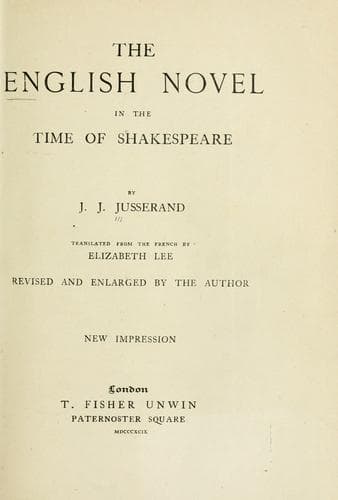
The English Novel in the Time of ShakespeareJusserand, J. J. (Jean Jules)
History
The English Novel in the Time of Shakespeare
Jusserand, J. J. (Jean Jules)
English fiction -- Early modern, 1500-1700 -- History and criticism
Nash, after the manner employed by More in his "Utopia," by Greene in
his "Ciceronis amor," and in our age, with a splendour of fame to which
several generations have already borne testimony, by Sir Walter Scott,
introduces historical personages in his fiction. The page Jack Wilton,
the hero of the tale, a little superior by his rank to the ordinary
_picaro_ has, like Gil Blas, little money in his pocket and a few odds
and ends of Latin in his head; he distributes in his conversation the
trite quotations that have remained by him, skilfully enough to persuade
the vulgar that he does not belong to their tribe. "Tendit ad sidera
virtus--Paulo majora canamus--Secundum formam statuti," &c., and from
time to time, when he is greatly elated and wishes to show himself in
all his magnificence, he adopts the elegances and similes proper to the
euphuistic style: "The sparrow for his lecherie liveth but a yeere,"
&c.[275]
Wilton is present first with the royal court of England at the siege of
Tournay, under Henry VIII. What my credit was at this court "a number of
my creditors that I coosned can testifie." He lives on the resources of
his wits, playing tricks worthy a whipping if not a hanging on
respectable persons of limited capacity. His most notable victim is the
purveyor of drink or victualler to the camp, a tun-bellied coward, proud
of his pretended noble descent, a Falstaff grown old, whose wit has been
blunted, who has ended by marrying Mistress Quickly, and has himself
become tavern keeper in partnership with her. In old days he drank on
credit: now the good fellows tipple at his expense. Such is the end of
all the Falstaffs and all the Scapins. "This great Lorde, this worthie
Lord," relates the wicked page, "thought no scorne, Lord have mercy upon
us, to have his great velvet breeches larded with the droppings of this
dainty liquor," that is, the cider that he sold; "and yet he was an olde
servitor, a cavelier of an ancient house, as it might appeare by the
armes of his ancestrie, drawen very amiably in chalk, on the in side of
his tent doore."[276]
The scene between the fat, ruddy host, open-mouthed, blear-eyed, and the
frolicking slender page, who delights in his tricks and covers his
victim with jesting compliments, is extremely well described. Wilton
finds his man "counting his barrels, and setting the price in chalke on
the head of everie one of them." He addresses him his "duty verie
devoutly," and tells him he has matters of some secrecy to impart to him
for which a private audience is necessary:
"With me, young Wilton? quoth he, marie and shalt. Bring us a pint of
syder of a fresh tap into the 'Three Cups'[277] here; wash the pot!
"So into a backe roome he lead mee, where after hee had spit on his
finger, and picked off two or three moats of his olde moth eaten velvet
cap, ... he badde me declare my minde, and there upon he dranke to me on
the same."
Public-domain text, read in full here on John Shaqi.
Reviews
Reviews
No reviews yet
Be the first to share your thoughts on this work.
Elsewhere in the archive
Join the Discussion
Join the discussion
Sign in to leave a comment or review.
Sign InorCreate an account