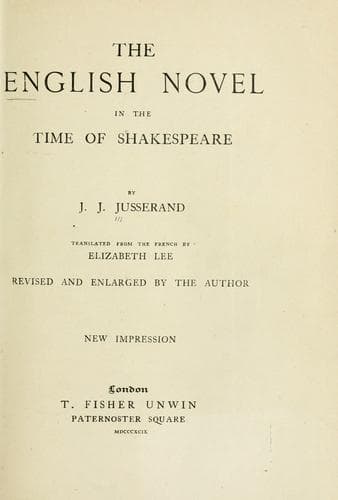
The English Novel in the Time of ShakespeareJusserand, J. J. (Jean Jules)
History
The English Novel in the Time of Shakespeare
Jusserand, J. J. (Jean Jules)
English fiction -- Early modern, 1500-1700 -- History and criticism
Nash, with like heedlessness, often interposes in his own person, and
takes the words out of his page's mouth; and his bold, characteristic
and concise opinions are very curious in the history of manners and
literature. For example, when he describes the war of the Anabaptists
and the execution of John of Leyden, he sums up thus in a short pithy
sentence the current opinion of his day among literary people and men of
the world, on the already formidable sect of the Puritans: "Heare what
it is to be Anabaptists, to bee puritans, to be villaines: you may be
counted illuminate botchers for a while, but your end wil be: Good
people pray for me."
His open admiration of the charity of the Catholics at Rome reveals in
him great independence of mind and much courage: "Yet this I must say to
the shame of us Protestants, if good workes may merit heaven they doo
them, we talke of them. Whether superstition or no makes them
unprofitable servants, that let pulpets decide: but there, you shall
have the bravest Ladies in gownes of beaten gold, washing pilgrimes and
poore souldiours feete, and dooing nothing they and their wayting mayds
all the yeare long, but making shirts and bandes for them against they
come by in distresse."
At Wittenberg, Wilton sees "Acolastus" performed, an old play that was
as popular in England as on the continent,[278] and Nash's severe
criticism on the actors shows how well the difference between good
comedians and common players was understood in London. Nash shared
Shakespeare's opinion of the actors who "out-heroded Herod," and he
would have been of Moliere's way of thinking about the performances at
the Hotel de Bourgogne: "One as if he had beene playning a clay floore,
stampingly troade the stage so harde with his feete, that I thought
verily he had resolved to doe the carpenter that sette it uppe some
utter shame. Another floung his armes lyke cudgelles at a peare tree,
insomuch as it was mightily dreaded that hee woulde strike the candles
that hung above theyr heades out of their sockets, and leave them all
darke." This severe criticism may serve to reassure us about the way in
which the great English dramas were interpreted at that period.[279] And
indeed they deserved that some trouble should be taken with them, for
in London it was the time of "Romeo and Juliet," of "Midsummer Night's
Dream," of "Richard III."
Public-domain text, read in full here on John Shaqi.
Reviews
Reviews
No reviews yet
Be the first to share your thoughts on this work.
Elsewhere in the archive
Join the Discussion
Join the discussion
Sign in to leave a comment or review.
Sign InorCreate an account