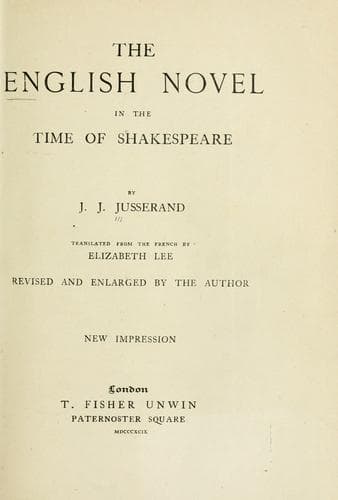
The English Novel in the Time of ShakespeareJusserand, J. J. (Jean Jules)
History
The English Novel in the Time of Shakespeare
Jusserand, J. J. (Jean Jules)
English fiction -- Early modern, 1500-1700 -- History and criticism
Soon the page takes up the course of his adventures again, and travels
anew on the continent. He visits Venice, Florence, Rome, refraining with
a care for which he is to be thanked from trite descriptions. What's the
good of describing the monuments of Rome? he says; everybody knows them:
"he that hath but once drunke with a traveller, talkes of them." Sir
Thomas More contemplating his "Utopia," John of Leyden dragged to the
scaffold, the Earl of Surrey jousting for the fair Geraldine "against
all commers," Francis I., conqueror at Marignan, Erasmus, Aretino, "one
of the wittiest knaves that ever God made," and other personages of the
Renaissance, figure in the narrative. Faithful to the picaresque plot,
Nash conducts his reader into all societies, from the tavern to the
palace, from the haunt of robbers to the papal court, and makes his hero
no better than he should be. At Marignan, Wilton occupies himself
especially in discovering quickly who is likely to be the strongest, in
order to attach himself ardently to the winner. At Venice he runs away
with an Italian lady, deserts his master, the Earl of Surrey, and passes
himself off as the Earl.
All this is too much at length for honest Nash, and feeling not less
displeased than ourselves with the wicked actions of his hero, he
himself interposes at times, not without disadvantage to his plot, and,
in spite of the improbability of placing such remarks in Wilton's mouth,
introduces his own opinions on the persons and incidents of the romance.
This is an effect of the impetuosity of his temperament, blameable
undoubtedly from an artistic point of view. We shall be indulgent to him
if we remember that no author of the time was entirely master of himself
and faithful to his plot. Even Shakespeare rarely resists like
temptation, and when a poetic image comes into his mind, little matters
it to him what character is on the stage; he makes of him a dreamer, a
poet, and lends to him the exquisite language of his own emotion. Let
us remember how the murderers hired to assassinate Edward's children
describe the scene of the murder. They saw "the gentle babes ...
girdling one another
Within their alabaster innocent arms:
Their lips were four red roses on a stalk,
And, in their summer beauty, kiss'd each other."
A very improbable remark, it will be admitted, on the part of the
murderers. But, then, it is Shakespeare who talks aloud, forgetting that
he is supposed not to be there.
Public-domain text, read in full here on John Shaqi.
Reviews
Reviews
No reviews yet
Be the first to share your thoughts on this work.
Elsewhere in the archive
Join the Discussion
Join the discussion
Sign in to leave a comment or review.
Sign InorCreate an account