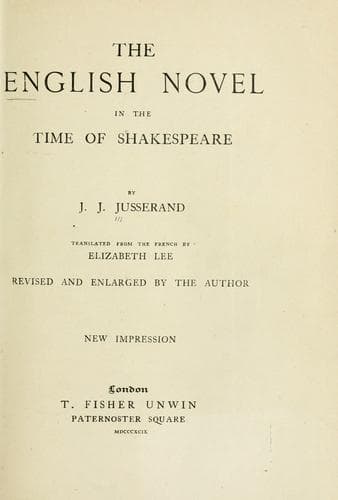
The English Novel in the Time of ShakespeareJusserand, J. J. (Jean Jules)
History
The English Novel in the Time of Shakespeare
Jusserand, J. J. (Jean Jules)
English fiction -- Early modern, 1500-1700 -- History and criticism
Wilton is accused of murders committed in his house; the rope almost
about his neck, he is saved by an English earl, in exile, who seems to
have been imbued with Ascham's teaching, and who reproaches him for
travelling, especially in Italy, where morals are so corrupt and where
immorality is so dangerous. "Take care," said the earl, "if thou doest
but lend halfe a looke to a Romans or Italians wife, thy porredge shall
bee prepared for thee, and cost thee nothing but thy life." The earl,
who proves to be a rather pedantic nobleman, passes in review all
nations, and proves that they are not worth the trouble of going to see.
Wilton, whose personal experience does not justify such unfavourable
prognostications, especially now that he is out of danger, is wearied by
this talk, and, pretending important business, gives his chattering
benefactor the slip. He is soon punished; he is captured by the Jews of
Rome; his adventures become more and more mysterious and alarming, and
more and more does melodrama invade the story.
Sometimes, however, in the midst of these abominations, Nash's tone
rises; his language becomes eloquent and his emotion infectious; he
shudders himself, horror penetrates him and seizes us; the jests of the
picaroon are very far from our mind, the drama is then as terrible as
with the most passionate romanticists of our century in their best
moments.
Few stories of our day are better contrived to give the sense of the
horrible than the story of the vengeance of Cutwolfe related by himself
just as he is going to be tortured. After a prolonged search, Cutwolfe
at last finds his enemy, Esdras of Granada, alone, in his shirt, and far
from all help. The unfortunate man implores Cutwolfe, whose brother he
had killed, to make it impossible for him to do any more harm, to
mutilate him, but to spare his life. His enemy replies: "Though I knewe
God would never have mercie on mee except I had mercie on thee, yet of
thee no mercie would I have.... I tell thee, I would not have undertooke
so much toyle to gaine heaven, as I have done in pursuing thee for
revenge. Divine revenge, of which, as one of the joies above, there is
no fulnes or satietie. Looke how my feete are blistered with following
thee from place to place. I have riven my throat with overstraining it
to curse thee. I have ground my teeth to powder with grating and
grinding them together for anger, when anie hath nam'd thee. My tongue
with vaine threates is bolne, and waxen too big for my mouth....
Entreate not, a miracle maye not reprive thee."
The scene is prolonged. Esdras continues to beg for his life; he will
become the slave, the chattel of his enemy. An idea comes into the mind
of the latter: Sell thy soul to the devil, and I will pardon thee.
Esdras immediately utters horrible blasphemies.
Public-domain text, read in full here on John Shaqi.
Reviews
Reviews
No reviews yet
Be the first to share your thoughts on this work.
Elsewhere in the archive
Join the Discussion
Join the discussion
Sign in to leave a comment or review.
Sign InorCreate an account