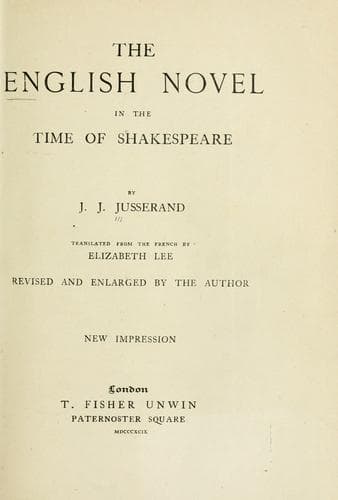
The English Novel in the Time of ShakespeareJusserand, J. J. (Jean Jules)
History
The English Novel in the Time of Shakespeare
Jusserand, J. J. (Jean Jules)
English fiction -- Early modern, 1500-1700 -- History and criticism
"My joints trembled and quakt," continues Cutwolfe, "with attending
them, my haire stood upright, and my hart was turned wholly to fire....
The veyne in his left hand that is derived from his heart with no faint
blow he pierst, and with the bloud that flowd from it, writ a ful
obligation of his soule to the divell: yea more earnestly he praied unto
God never to forgive his soule than manie Christians doo to save theyr
soules. These fearfull ceremonies brought to an end, I bad him ope his
mouth and gape wide. He did so: as what wil not slaves doo for feare?
Therwith made I no more adoo, but shot him ful into the throat with my
pistol: no more spake he after; so did I shoote him that hee might never
speak after, or repent him. His body being dead lookd as black as a
toad."[280]
This conversation and the sight of Cutwolfe's horrible punishment,
recall Jack Wilton to himself. He regrets his irregular life, but not to
the point of refunding the money stolen from the Countess Juliana; rich
as Gil Bias, he can now, like him, take rank among peaceable and settled
folk; he marries his Venetian lady, and returns to the king of England's
army, occupied in giving a grand reception to Francis I. at the Field of
the Cloth of Gold. There ends the most complete career furnished in
England, before Defoe, by a character of fiction.
The primary if not only result of the publication of "Jack Wilton" was,
so far as the author himself was concerned, to place him in new
difficulties. His well-known satirical vein, his constant use and abuse
of allusions, which often render him obscure, were so well known that it
was considered improbable that he had been writing this time with a
merely artistic aim. He had been careful to state in his dedication that
readers would merely find in his book "some reasonable conveyance of
historie and varietie of mirth," and that he was attempting a kind of
writing new to him; it was to no purpose. Readers were on the look-out
for allusions; they took his historical heroes for living people but
thinly disguised, and lined Nash's story with another of their own
invention. The author, who well knew the dangers of such
interpretations, never ceased to protest that, in this work at least,
there was no place for them. When once the public is started upon such a
track, it is no easy matter to make them turn round. Nash had recourse
to his usual revenge, that is, to laugh at his interpreters. "I am
informed," he wrote, shortly after his "Wilton" was printed, "there be
certaine busie wits abrode that seeke to anagrammatize the name of
Wittenberge to one of the Universities of England; that scorn to be
counted honest, plaine meaning men, like their neighbours, for not so
much as out of mutton and potage, but they will construe a meaning of
kings and princes. Let one but name bread, but they will interpret it to
be the town of Bredan in the Low countreyes; if of beere he talkes, then
Public-domain text, read in full here on John Shaqi.
Reviews
Reviews
No reviews yet
Be the first to share your thoughts on this work.
Elsewhere in the archive
Join the Discussion
Join the discussion
Sign in to leave a comment or review.
Sign InorCreate an account