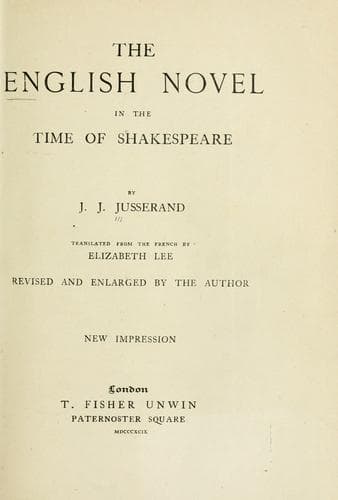
The English Novel in the Time of ShakespeareJusserand, J. J. (Jean Jules)
History
The English Novel in the Time of Shakespeare
Jusserand, J. J. (Jean Jules)
English fiction -- Early modern, 1500-1700 -- History and criticism
Of the misrule in Crete, and of the dangers AEliana runs from the
incestuous passions of her uncle, and of her escape through the
providential intervention of Prince AEmilius, we shall say nothing; nor
of the "frolicke common-wealth" established in Thrace, feeling as we do
some sympathy with Corydon, who interrupts the speaker, saying: "Reach
hither thy bottle that we may drinke round; I am sure thou must needes
be dry with talking when I am so a thirst with hearing." Piers passes
from the court to the shop of a dealer in old clothes and an usurer. He
leads a very miserable life, and we have sordid descriptions of scenes
in low life with which Chettle was better acquainted than with the loves
of AEmilius and AEliana. Princes and princesses come in again; there are
revolutions, awful dangers and marvellous deliverances. All ends
happily, and Piers and his hearers agree to meet "at theyr ploughman's
holidaye. Where what happened, if Piers Plainnes please, shall per
adventure be published." This "adventure" never took place. The
incoherent mixture of the picaresque, romantic, and Arcadian tale
resulted in such an unpalatable compound that even novel-readers of
Shakespeare's time objected to a narration of this kind, and did not
trouble Chettle with a demand for its continuation.
His reputation therefore rests mainly on his dramas. One of his most
frequent associates in writing them, and one of the most prolific and
gifted, Thomas Dekker, was also something of a novelist. He has left,
besides a great quantity of plays, a number of pamphlets written very
much in Nash's vein,[292] in which there is some excellent realism,
together with the most amusing and whimsical fancies.[293] His
biography is a mere repetition of his friend's life, and the words:
Henslowe, drama, penury, pamphlets, prison, quarrels, put together, will
give a sufficient idea of the sort of existence led by him as well as by
so many of his associates.[294] He wrote some of his plays alone, many
others with numberless collaborators, such as Chettle, Drayton, Wilson,
Ben Jonson (with whom he afterwards had a violent quarrel), Haughton,
Day, Munday, Hathaway, Middleton, Webster, Heywood, Wentworth Smith,
Massinger, Ford, Rowley, and even others, for the dramatic faculty was
then so very common that any one, so to say, was good enough to act as a
collaborator in writing plays.
Public-domain text, read in full here on John Shaqi.
Reviews
Reviews
No reviews yet
Be the first to share your thoughts on this work.
Elsewhere in the archive
Join the Discussion
Join the discussion
Sign in to leave a comment or review.
Sign InorCreate an account