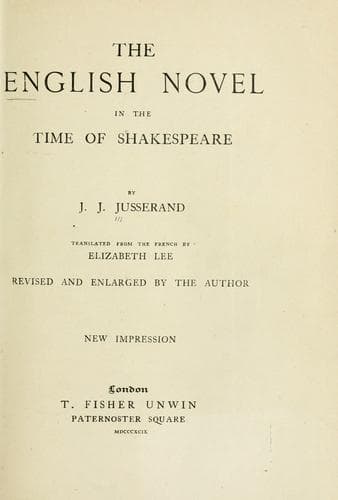
The English Novel in the Time of ShakespeareJusserand, J. J. (Jean Jules)
History
The English Novel in the Time of Shakespeare
Jusserand, J. J. (Jean Jules)
English fiction -- Early modern, 1500-1700 -- History and criticism
He had many traits in common with Nash: the same excellent faculty of
observation, the same gaiety and _entrain_, with powers of his own to
associate it with the most exquisite tenderness and pathos; the same
love for literature and for the poets, for Chaucer, for Spenser, whose
arrival in the Elysian fields he describes in a way to tempt the pencil
of a painter: "Grave Spenser was no sooner entred into this chappell of
Apollo, but these elder fathers of the divine furie gave him a lawrer
and sung his welcome; Chaucer call'd him his sonne and plac'd him at his
right hand. All of them, at a signe given by the whole quire of the
Muses that brought him thither, closing up their lippes in silence, and
turning all their eares for attention to heare him sing out the rest of
Fayrie Queenes prayses."[295]
But a marked difference between Dekker and Nash resulted from the fact
that Dekker had not only a love of poetry, but a poetical faculty of a
high order. He went far beyond the picturesqueness of Nash's
word-painting, and reached in his prose as well as in his verse true
lyrical emotion and pathos; he had, said Lamb, "poetry enough for
anything;"[296] and while Nash's gaiety, true and hearty as it is,
takes often and naturally a bitter satirical turn, Dekker's gaiety
though sometimes bitter, more usually takes a pretty, graceful, and
fanciful turn. "Come, strew apace, strew, strew: in good troth tis a
pitty that these flowers must be trodden under feete as they are like to
be anon ...
[Illustration: "DEKKER HIS DREAM."]
"Pitty? come foole, fling them about lustily; flowers never dye a
sweeter death than when they are smoother'd to death in a Lovers bosome,
or else pave the high wayes over which these pretty, simpering, setting
things call'd brides must trippe."[297]
Intimate literary ties, however, existed between Nash and Dekker; many
passages in the one remind us of similar things in the other, the result
sometimes of actual imitation, sometimes of involuntary reminiscences.
Dekker was well aware of the family likeness between the two, so much so
that we see him once calling Nash's ghost to his assistance, as one from
whom he might most naturally gain help: "And thou into whose soule ...
the raptures of that fierie and inconfinable Italian spirit were
bounteously and boundlesly infused; thou sometimes secretary to Pierce
Pennylesse and master of his requests, ingenious, ingenuous, fluent,
facetious T. Nash, from whose aboundant pen hony flow'd to thy friends,
and mortall aconite to thy enemies; thou that madest the doctor a flat
dunce[298] ... sharpest satyre, luculent poet, elegant orator, get leave
for thy ghost to come from her abiding and to dwell with me
awhile."[299]
Public-domain text, read in full here on John Shaqi.
Reviews
Reviews
No reviews yet
Be the first to share your thoughts on this work.
Elsewhere in the archive
Join the Discussion
Join the discussion
Sign in to leave a comment or review.
Sign InorCreate an account