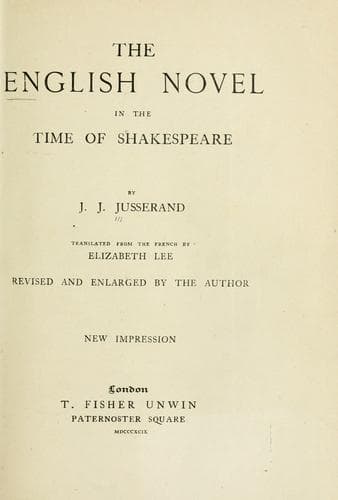
The English Novel in the Time of ShakespeareJusserand, J. J. (Jean Jules)
History
The English Novel in the Time of Shakespeare
Jusserand, J. J. (Jean Jules)
English fiction -- Early modern, 1500-1700 -- History and criticism
"At last a tinker came sounding through the towne, mine hosts being the
auncient watring place where he did use to cast anchor. You must
understand he was none of those base rascally tinkers that with a bandog
and a drab at their tayles and a picke staffe at their necks will take a
purse sooner then stop a kettle. No this was a devout tinker, he did
honor God Pan; a musicall tinker, that upon his kettle-drum could play
any countrey-dance you cald for, and upon Holly-dayes had earned money
by it, when no fidler could be heard of. Hee was onely feared when he
stalkt through some towns where bees were, for he strucke so sweetely on
the bottome of his copper instrument that he would emptie whole hives
and leade the swarmes after him, only by the sound."
These two beings, the host and tinker, depicted as vividly by Dekker as
Callot would have drawn them, meet in the open air, and the former
offers the tinker a crown if he undertakes to bury the dead man. The
tinker haggles for better payment and they agree for ten shillings.
"The whole parish had warning of this presently ... therefore ten
shillings were leveyed out of hand, put into a rag, which was tyed to
the ende of a long pole and delivered, in sight of all the parish, who
stood aloofe stopping their noses, by the head boroughs owne selfe in
proper person." Nothing dismayed by this awful array, the tinker sits at
table, drinks deep, takes the corpse on his back and carries it to a
field. Before committing it to the earth he carefully searches its
pockets and empties them; he then makes a parcel of the clothes "and
carrying that at the end of his staffe on his shoulder, with the purse
of seven pounds in his hand, backe againe comes he through the towne,
crying aloud: 'Have you any more Londoners to bury; Hey downe a downe
dery; Have you any more Londoners to bury?' The Hobbinolls running away
from him as if he had beene the dead citizens ghost, and he marching
away from them in all the hast he could, with that song still in his
mouth."
Another sort of writing congenial to Dekker's temperament, and which
novelists of a later date continued to cultivate after him, are those
series of counsels or praises in which, with due seriousness, the thing
is recommended or praised which ought to be avoided. An example of this
kind of satirical composition is the famous "Quinze joyes de mariage,"
in which the pleasant humours of a young wife are described in such a
way as to deter even a Panurge from marrying. Another example is the
"Grobianus"[303] Latin poem of the German F. Dedekind, which enjoyed an
immense reputation throughout Europe in the sixteenth century; it
contains ironical advice to a gallant with regard to his behaviour so
that in any given circumstances he may be as objectionable and improper
as possible.
Public-domain text, read in full here on John Shaqi.
Reviews
Reviews
No reviews yet
Be the first to share your thoughts on this work.
Elsewhere in the archive
Join the Discussion
Join the discussion
Sign in to leave a comment or review.
Sign InorCreate an account