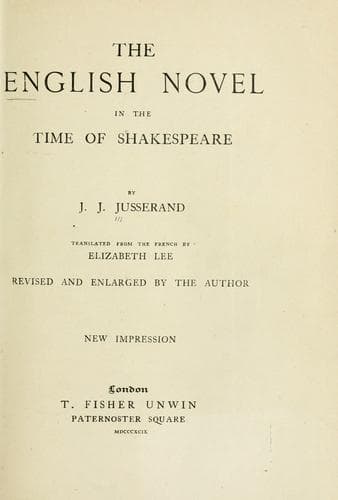
The English Novel in the Time of ShakespeareJusserand, J. J. (Jean Jules)
History
The English Novel in the Time of Shakespeare
Jusserand, J. J. (Jean Jules)
English fiction -- Early modern, 1500-1700 -- History and criticism
Dekker did not write novels properly so called, but his prose works
abound with scenes that seem detached from novels, and that were so well
fitted for that kind of writing that we find them again in the works of
professional novelists of his or of a later time. His "Wonderfull yeare
1603," from which Defoe seems to have taken several hints, abounds in
scenes of this sort.[301] It is a book "wherein is shewed the picture
of London lying sicke of the plague. At the ende of all, like a mery
epilogue to a dull play sundry tales are cut out in sundry fashions of
purpose to shorten the lives of long winters nights that lye watching in
the darke for us." Some of these tales are extremely well told, for
Dekker is more successful in describing the humours than the terrors of
the plague. In one of them we find another copy of the fat hostler so
well described already by Nash and, as it seems, inspired by a
reminiscence of the picture in "Jack Wilton." Dekker's man is not
thinner, cleaner, nor braver than Nash's victualler. He is a country
innkeeper: "a goodly fat burger he was, with a belly arching out like a
beere-barrell, which made his legges, that were thicke and short like
two piles driven under London bridge.... In some corners of [his nose]
there were blewish holes that shone like shelles of mother of pearle ...
other were richly garnisht with rubies, chrisolites, and carbunckles,
which glistered so oriently, that the Hamburgers offered I know not how
many dollars for his companie in an East-Indian voyage, to have stoode a
nightes in the poope of their Admirall, onely to save the charge of
candles.
"In conclusion he was an host to be ledde before an Emperour, and though
he were one of the greatest men in all the shire, his bignes made him
not proude, but he humbled himself to speake the base language of a
tapster, and uppon the Londoners first arrival, cried: 'Welcome! a cloth
for this gentleman!' The linnen was spread and furnisht presently with
a new cake and a can, the roome voided, and the guest left, like a
French Lord, attended by no bodie."[302]
This new-comer, freshly arrived from London was flying on account of the
plague; but it so happened that he had himself already contracted the
disease; he was scarcely seated before it grew upon him and he fell
dead. Great was the terror in the inn. The host, the maids, all the
inmates ran from the corpse and left the house; the terror spread in the
borough; no one would even walk near the place.
Public-domain text, read in full here on John Shaqi.
Reviews
Reviews
No reviews yet
Be the first to share your thoughts on this work.
Elsewhere in the archive
Join the Discussion
Join the discussion
Sign in to leave a comment or review.
Sign InorCreate an account