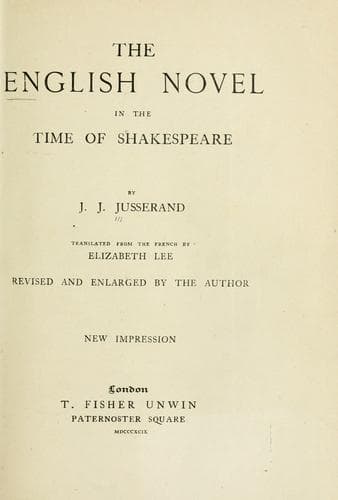
The English Novel in the Time of ShakespeareJusserand, J. J. (Jean Jules)
History
The English Novel in the Time of Shakespeare
Jusserand, J. J. (Jean Jules)
English fiction -- Early modern, 1500-1700 -- History and criticism
During the greater part of the century French romances were in England
the main reading of people who had leisure. They were read in the
original, for French was a current language in society at that time, and
they were read in translations both by society and by the ordinary
public. Most of them were rendered into English, and so important were
these works considered that sometimes several translators tried their
skill at the same romance, and published independently the result of
their labours, as if their author had been Virgil or Ariosto, or any
classical writer. French ideas in the matter of novels were adopted so
cordially that not only under Charles I., but even during the civil war
and under Cromwell this rage for reading and translating did not abate.
The contrary, it is true, has often been asserted, without inquiry, and
as a matter of course; but this erroneous statement was due to a mere
_a priori_ argument, and had no other ground than the improbability of
the same fashion predominating in the London of the Roundheads and the
Paris of the Precieuses. What likelihood was there of any popularity
being bestowed upon heroes who were nothing if not befeathered heroes,
heroes _a panaches_ at a time when Puritans reigned supreme, staunch
adversaries as we know of _panaches_, curls, vain talk, and every sort
of worldly vanity? Was it not the time when books were published on "The
unlovelinesse of Love-lockes," being "a summarie discourse prooving the
wearing and nourishing of a locke or love-locke to be altogether
unseemely, and unlawfull unto Christians. In which there are likewise
some passages collected out of Fathers, Councells and sundry authors and
historians against face-painting, the wearing of supposititious,
poudred, frizled or extraordinary long haire, the inordinate affectation
of corporall beautie, and womens mannish, unnaturall, impudent, and
unchristian cutting of their haire"?[326] So early in the century as
1628 it was thus discovered that women's short hair and men's long wigs
were equally unchristian. What was to be the fate of our well-curled
heroes? They were received with open arms. "Polexandre," for example,
was published in English in 1647; "Ibrahim ou l'illustre Bassa,"
"Cassandre," and "Cleopatre" in 1652; "Le Grand Cyrus" in 1653, the very
year in which Cromwell became Protector; the first part of "Clelie" in
1656; "Astree" in 1657; "Scipion" in 1660, &c.
The English prefaces to these French novels plainly showed that,
notwithstanding the puritanical taunts of the party in power, publishers
felt no doubt as to the success of their undertaking. These works were
not spread timidly among the public; they were announced noisily in the
most pompous terms:
Public-domain text, read in full here on John Shaqi.
Reviews
Reviews
No reviews yet
Be the first to share your thoughts on this work.
Elsewhere in the archive
Join the Discussion
Join the discussion
Sign in to leave a comment or review.
Sign InorCreate an account